 Jambolaya
Pinochle
How to play
Four players in two partnerships play a 48-card pinochle deck — TWO copies of the 9, J, Q, K, 10 and A in every suit, and the 10 outranks the K.
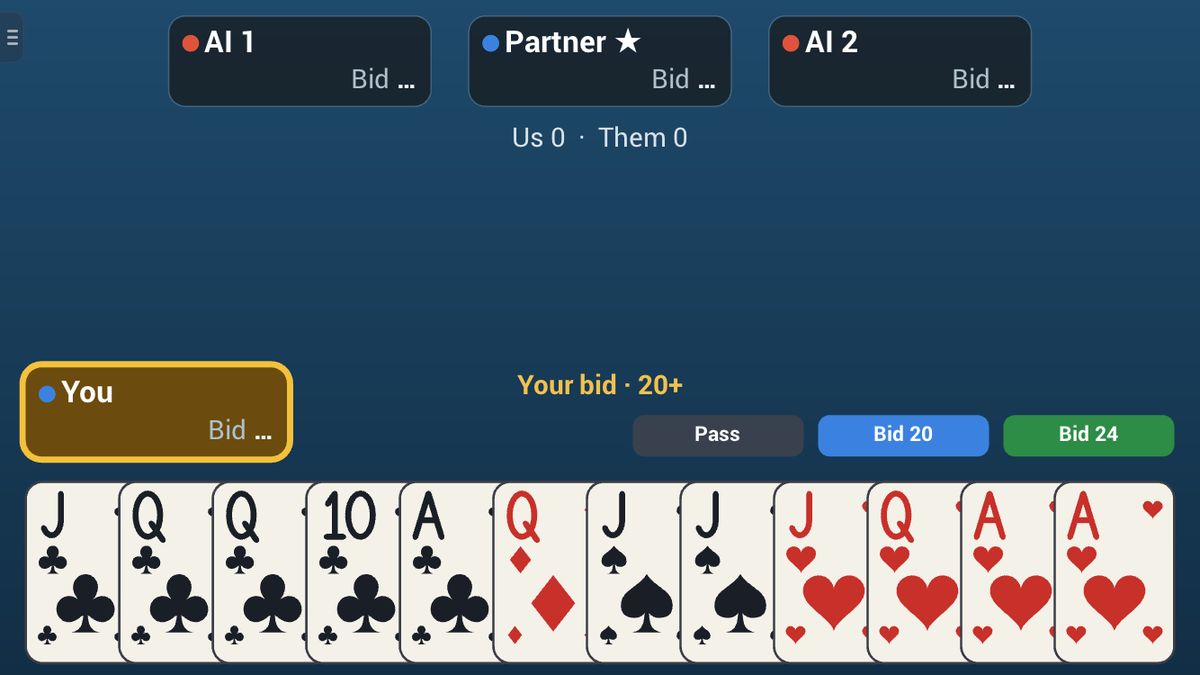
Each hand, an auction starting left of the dealer sets the contract: bid higher than the standing bid (20 minimum) or pass — a pass is final, and if the first three players pass the dealer is stuck with 20.
The winner names trump and everyone's meld is revealed: runs, marriages, the dix, aces/kings/queens/jacks around, and the pinochle (J♦ + Q♠). Then play 12 tricks — follow the led suit if you can; if you're void you MUST trump if you can.
The highest trump wins, else the highest card of the led suit; of two identical cards the FIRST played wins. Each Ace, Ten and King captured is a point, plus one for the last trick (25 per hand).
A team's meld only counts if it wins a trick, and the bidding team must make its bid in meld + counters or go set and lose the bid instead. First team to 100 wins — if both cross in the same hand, the bidders win.
Simplified: single deck, no passing cards between partners, no obligation to overtrump.
The aim
Pinochle is for four players in two teams; your partner sits across from you. Each hand, the teams bid to choose trumps, score for good groups of cards in their hands, called meld, then win tricks for more points. The first team to reach 100 wins.
The deck has 48 cards: two copies of the 9, Jack, Queen, King, 10 and Ace in every suit. From high to low the order is Ace, 10, King, Queen, Jack, 9.
How a turn works
Everyone gets 12 cards. A hand has three parts.
- The bidding. From the dealer's left, each player bids higher or passes. The lowest bid is 20, and the buttons raise by 1 or by 5. A pass is final for that hand. If the first three players pass, the dealer is stuck with 20.
- Trump and meld. The top bidder names the trump suit. The table then finds and shows everyone's meld.
- The tricks. The top bidder leads first. Follow the suit that was led if you can. If you can't, you must play a trump if you have one. The highest trump wins; with no trump, the highest card of the led suit. If two identical cards meet, the first one played wins. The winner leads next.
Meld values: a run (Ace, 10, King, Queen and Jack of trumps) is 15. King and Queen of trumps are 4, of another suit 2. Each 9 of trumps is 1. An Ace of every suit is 10, Kings 8, Queens 6, Jacks 4. The Jack of diamonds with the Queen of spades, the pinochle, is 4; both pairs of them are 30.
A small example: hearts are trumps and someone leads the Ace of clubs. You have no clubs but hold a 9 of hearts. You must play it, and your little trump takes the Ace.
Scoring and the end of the game
Each Ace, 10 and King you capture in tricks is 1 point, and the last trick is 1 more: 25 points in every hand.
A team's meld only counts if it wins at least one trick. If the bidding team's meld and trick points reach its bid, it scores them all. If not, it is "set" and loses the amount of its bid. The other team always keeps what it made.
The first team to 100 wins. If both pass 100 in the same hand, the bidding team wins.
Unlike many tables, partners never pass cards, and you never have to beat a trump already played.
Tips to play better
- Before bidding, count your meld in your best suit, plus a little for Aces and long trumps.
- Don't bid just to win the auction. Going set costs the whole bid.
- Lead your Aces early, before others run out of that suit and can trump them.
- Give a 10 or King to a trick your partner is winning; give a 9, Jack or Queen to one you are losing.
- Watch who is out of a suit. When it is led, they must trump.
Common mistakes
- Thinking the King beats the 10.
- Ducking every trick on defence. Your meld is lost unless your team takes at least one.
- Throwing an Ace, 10 or King into a trick the other team is sure to win.
Playing with family
Pinochle suits older children and grandparents who enjoy bidding and teamwork. The table adds up the meld for you, and only cards you may play are highlighted.
Against the computer you get a computer partner and two computer opponents, at Easy, Normal or Hard. A guided lesson covers bidding, trumps, the card order, meld and trick points. In the app, four people can also play together nearby, each on their own phone or tablet, with no Wi-Fi or internet needed. If you are fewer, computer players can fill the empty seats.
Ways to play
- Against the computerPlay on one device against a computer opponent.
- Play together, nearbyWith family and friends in the same room: up to 4 players, each on their own phone or tablet. No Wi-Fi or internet needed. In the Jambolaya app.
- Learn by playingA guided lesson on the real game teaches you the rules one step at a time.
 War1–2 players
 Old Maid1–6 players
 Briscola1–4 players
 Cheat1–6 players
 Big Two1–4 players
 Golf1–4 players
 Durak1–5 players
 Cucumber1–6 players