 Jambolaya
Word Grid
How to play
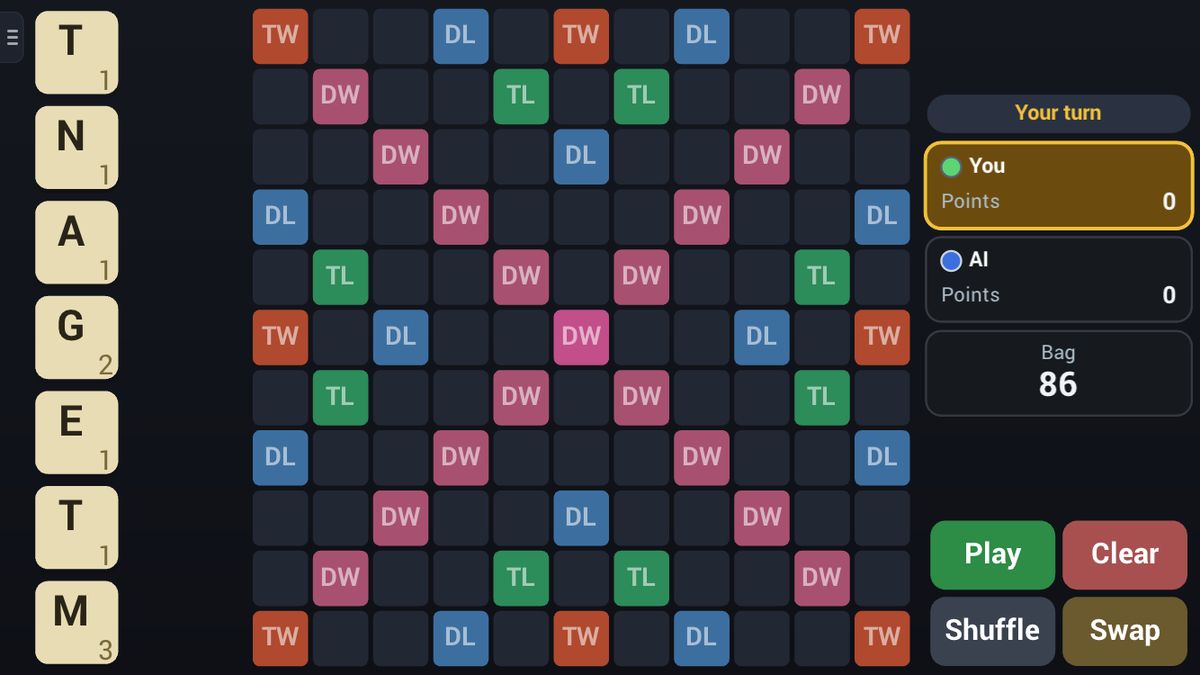
Draw seven letter tiles and take turns building words on the grid, crossword-style. Your first word must cross the centre; after that every new word must connect to one already on the board.
Tiles on coloured squares multiply the letter or the whole word, and using all seven tiles at once scores a bonus. Refill to seven after each turn; when the bag and a rack run out, the highest score wins.
Plays in your language with its own letters and dictionary.
The aim
Word Grid is a crossword game with letter tiles. Each player holds seven tiles that only they can see, each showing its points. Players take turns laying linked words on an 11 by 11 board. The highest score at the end wins.
How a turn works
On your turn you either play a word or swap.
- To play: tap a tile in your rack, then tap a square, letter by letter. All the new tiles must sit in one straight line, across or down, with no gaps.
- Tap a placed tile to take it back, or press Clear for all of them. Shuffle mixes your rack.
- Press Play. If every word you made is in the dictionary, you score and refill to seven from the bag. If not, the app buzzes and you can fix it.
- To swap: press Swap. All your tiles go back into the bag for new ones, and your turn ends. With fewer than seven tiles left in the bag, Swap simply passes.
The first word must cover the pink centre square. After that, every new word must touch a tile already on the board, anyone's. Any extra words you form must be real too, and each of them scores.
The bag holds two blanks. When you place one, you choose its letter; it scores nothing.
Scoring and the end of the game
A word scores the points of its letters. Coloured squares count only on the turn a tile is first placed on them:
- DL doubles one letter, TL triples it.
- DW doubles the whole word, TW triples it. The pink centre is a DW.
- Using all seven tiles in one turn earns 40 extra points.
An example in English, where C is worth 3 and A and T are worth 1: you spell CAT across the centre, 3 + 1 + 1 = 5, doubled to 10. An X, worth 8, counts 16 on a DL.
The game ends when the bag is empty and one player uses their last tile: everyone else loses the points left in their rack, and that player gains them all. It also ends when every player has passed or swapped twice in a row; then everyone loses their rack's points. Two players on the same score draw. With three or four, everyone sharing the top score draws and the rest lose.
Tips to play better
- Save big letters for coloured squares. An X or a Z on a TL is worth a lot.
- Hook onto words. Adding S to CAT makes CATS and scores the whole word.
- Short words count. Two-letter words fit tight spaces and can score twice, across and down.
- Guard the TW squares. Don't open an easy path to one.
- Swap a hopeless rack. One lost turn can beat several tiny scores.
Common mistakes
- Placing tiles in two different lines in one turn.
- Forgetting that every word your tiles touch must be real, not just the main one.
- Holding a high-value tile to the very end, when it costs you points.
Playing with family
Word Grid is good for spelling and counting, with no clock on a turn. It plays in the app's language, with its own letters, points and dictionary.
Against the computer, you choose two, three or four players and the computer's Difficulty, and you go first. On Easy the computer often picks a modest word; on Hard it plays the best-scoring word it finds.
The guided lesson plays a real game: a first word, a word through a tile on the board, a one-tile move and a swap.
In the app, two to four players can play together nearby, each on their own phone or tablet, with no Wi-Fi or internet needed. If someone leaves mid-game, the computer finishes in their seat. The browser edition plays on a single device.
Ways to play
- Against the computerPlay on one device against a computer opponent.
- Play together, nearbyWith family and friends in the same room: up to 4 players, each on their own phone or tablet. No Wi-Fi or internet needed. In the Jambolaya app.
- Learn by playingA guided lesson on the real game teaches you the rules one step at a time.
 Crate Push1–2 players
 Shape Swap1–2 players
 Letter Ring1–4 players
 Star Battle1–4 players
 Lot Slide1–4 players
 Color Sort1–4 players
 Join the Pairs1–4 players
 Minesweeper Duel1–2 players