 Jambolaya
Chess
How to play
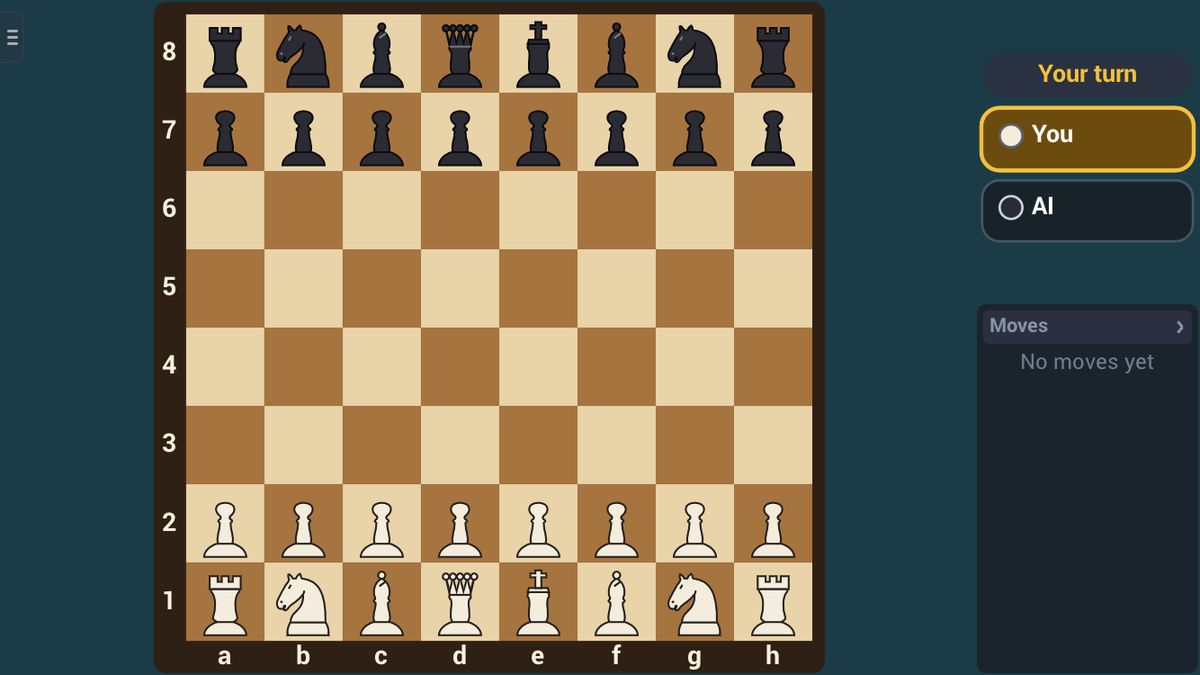
Every piece moves its own way — pawns advance and capture diagonally, rooks move in straight lines, bishops diagonally, the queen in any direction, the knight in an L, the king one square. Capture by landing on an enemy piece.
Trap the enemy king so it cannot escape capture — checkmate — to win.
The aim
Each player has 16 pieces: eight pawns, two rooks, two knights, two bishops, a queen and a king. You win by checkmate: attacking the enemy king so that it has no way out. Kings are never actually taken.
How a turn works
White always moves first. Against the computer, choosing "You" to start means you play White. On your turn, tap a piece, then one of the lit squares it can reach.
- Pawn: one square straight forward, or two on its first move. It captures one square diagonally forward.
- Rook: any distance in a straight line along a row or column.
- Bishop: any distance diagonally.
- Queen: any distance in all eight directions.
- Knight: an L shape, two squares one way and one to the side. It can jump over other pieces.
- King: one square in any direction.
You capture by moving onto an enemy piece, which leaves the board. Three special moves:
- Promotion. A pawn that reaches the far row becomes a queen, rook, bishop or knight. You pick, and the queen is almost always best.
- Castling. Once a game, the king moves two squares toward a rook, and the rook hops over it. Neither may have moved yet, the squares between must be empty, and the king may not be in check or cross an attacked square.
- En passant. If an enemy pawn moves two squares and lands beside yours, your pawn may capture it as if it had moved one. Only on the very next move.
When your king is attacked, it is in check, and you must end it at once: move the king, block the attack, or capture the attacker. You may never leave your own king in check; only legal moves light up.
Scoring and the end of the game
There are no points. Checkmate wins the game. The game is a draw when:
- The player to move is not in check but has no legal move. This is stalemate.
- The same position appears three times.
- 50 moves each go by with no pawn move and no capture.
- Neither side has enough pieces left to checkmate. In Jambolaya this is judged simply: no pawns, rooks or queens, and at most one bishop or knight each.
You can also play with a clock. Choose 1, 3, 5 or 10 minutes each, or no limit. With bonus time on, each move you make adds a few seconds. If your time runs out, you lose.
Tips to play better
- Early on, bring out your knights and bishops and push your middle pawns to claim the centre.
- Castle early. A king in the corner, behind its pawns, is much harder to attack.
- Before every move, ask what your opponent is threatening, and check that your pieces stay protected.
- Roughly, a pawn is worth 1, a knight or bishop 3, a rook 5 and the queen 9. Don't trade a big piece for a small one.
- Way ahead? Watch out for stalemate. Leave the losing king a square to move to until you can checkmate.
Common mistakes
- Bringing the queen out too early, where she gets chased around and wastes moves.
- Leaving the pawn beside your king unguarded. A fast queen-and-bishop attack on it is a famous four-move checkmate.
- Grabbing a piece that was bait.
Playing with family
Chess grows with a child, and lit squares keep every move legal. Grandparents who know the game can take on the harder computer levels.
Jambolaya offers six computer levels: Easy, Normal, Hard, Very Hard, Expert and Master. You can play one game or best of 3 or 5, and copy the list of moves. The guided lesson explains check, castling, promotion and stalemate, then has you play the four-move checkmate yourself. In the app, two players can also play together nearby, each on their own phone or tablet, with no Wi-Fi or internet needed.
Ways to play
- Against the computerPlay on one device against a computer opponent.
- Play together, nearbyOne-on-one with someone in the same room, each on your own phone or tablet. No Wi-Fi or internet needed. In the Jambolaya app.
- Learn by playingA guided lesson on the real game teaches you the rules one step at a time.
 Dots & Boxes1–2 players
 Ship Battle1–2 players
 Backgammon1–2 players
 Mancala1–2 players
 Nine Men's Morris1–2 players
 Hex1–2 players
 Go1–2 players
 Race Home1–4 players