 Jambolaya

Hex
How to play
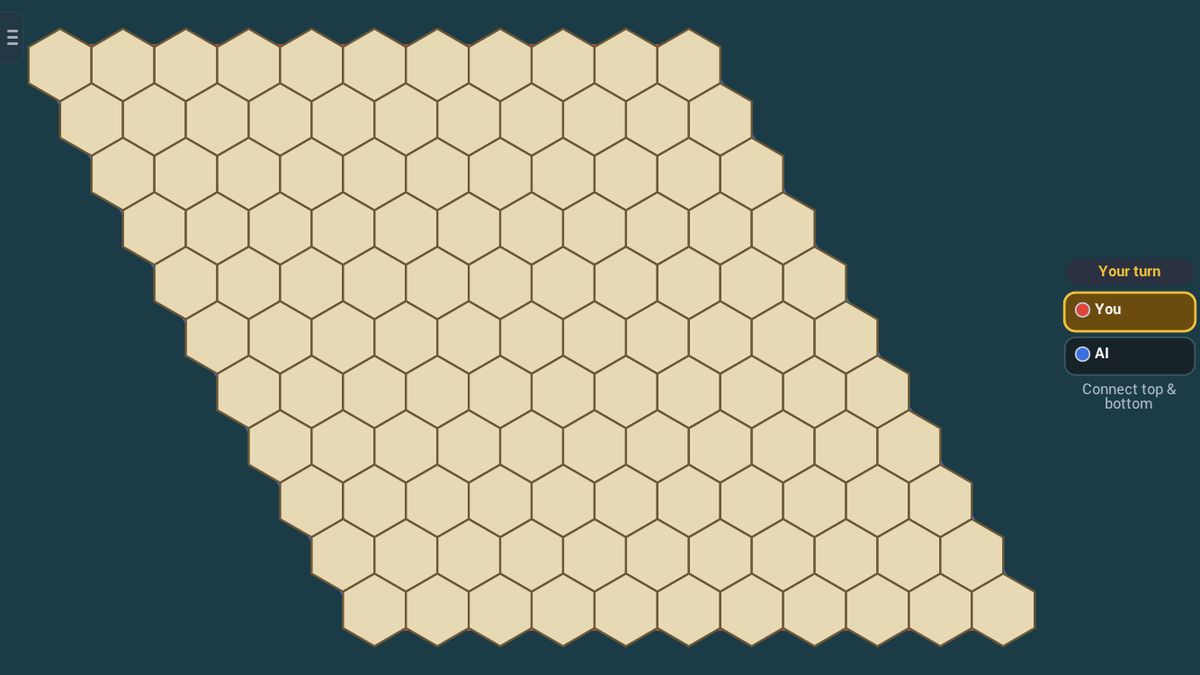
Take turns placing a stone on an empty cell. You own two opposite sides of the board, your opponent the other two. Connect your two sides with an unbroken chain of your own stones to win — in Hex a draw is impossible.
The aim
Hex is played on a diamond-shaped board of 11 by 11 six-sided cells, by Red and Blue. Each player owns two opposite edges, coloured in their colour. Red must join the top edge to the bottom edge, and Blue the left edge to the right edge. The first player to link their two edges with an unbroken chain of their own stones wins.
How a turn works
Red always places the first stone. Against the computer, if you choose to start, you are Red; otherwise you are Blue.
- On your turn, tap any empty cell to place one of your stones there.
- That is the whole move. You never pass, and you place only one stone.
- Stones never move and are never captured. Each one stays put until the end.
Stones are joined when their cells touch, and each cell touches up to six others. A chain may bend and twist as it likes, as long as it is unbroken.
A small example. You are Red and start in the centre. Blue places a stone right beside yours. That one stone does two jobs: it gets in your way, and it starts Blue's own chain. You answer by growing towards your edges, one cell up from your first stone.
Scoring and the end of the game
There are no points. The game ends the moment one player's chain touches both of their edges, and the winning chain lights up.
Hex can never end in a draw. When the board is full, exactly one player has a chain, because the only way to stop a chain is to build your own across it. Against the computer you can play a single game, or a best of 3 or 5.
Many Hex players use a "swap" rule so the first stone is not too strong. Jambolaya leaves it out.
Tips to play better
- Start near the centre. A stone in the middle can reach out in every direction. A stone near a corner helps very little.
- Use the bridge. Place two of your stones so they share two empty cells between them. If your opponent takes one of those cells, take the other. The stones stay linked whatever happens.
- Make every stone do two jobs. The best cell grows your chain and also cuts across your opponent's path.
- Block from a distance. A stone right in front of an enemy stone is easy to walk around. One a little further ahead is much harder to pass.
- Secure the last step. A stone in the second row from your edge is safe while both edge cells beside it are empty: if one is taken, take the other.
Common mistakes
- Racing for your own edges and forgetting that your opponent is racing too.
- Building a chain in a straight line, one cell at a time. It is slow and easy to block.
- Answering every enemy stone right next to it, instead of looking at the whole board.
- Missing a gap in your chain that has only one way through, which the other player can fill.
Playing with family
Hex has one rule, so a child learns it in a minute, while bridges and blocking give older players plenty to think about.
In Jambolaya you can play against the computer on Easy, Normal or Hard, and choose who starts. Easy sometimes places a stone at random, which gives a beginner room to win. The guided lesson shows the first stone, the race between the two chains, why there is never a draw and the bridge, then lets you finish a winning chain.
In the app you can also play together nearby, each on your own phone or tablet, with no Wi-Fi or internet needed. The browser edition plays on one device.
Ways to play
- Against the computerPlay on one device against a computer opponent.
- Play together, nearbyOne-on-one with someone in the same room, each on your own phone or tablet. No Wi-Fi or internet needed. In the Jambolaya app.
- Learn by playingA guided lesson on the real game teaches you the rules one step at a time.
 Go1–2 players
 Race Home1–4 players
 Snakes & Ladders1–4 players
 Chinese Checkers1–6 players
 Chinese Chess1–2 players
 Jungle Chess1–2 players
 Blob Spread1–4 players
 Halma1–4 players