 Jambolaya

Darts 3D
How to play
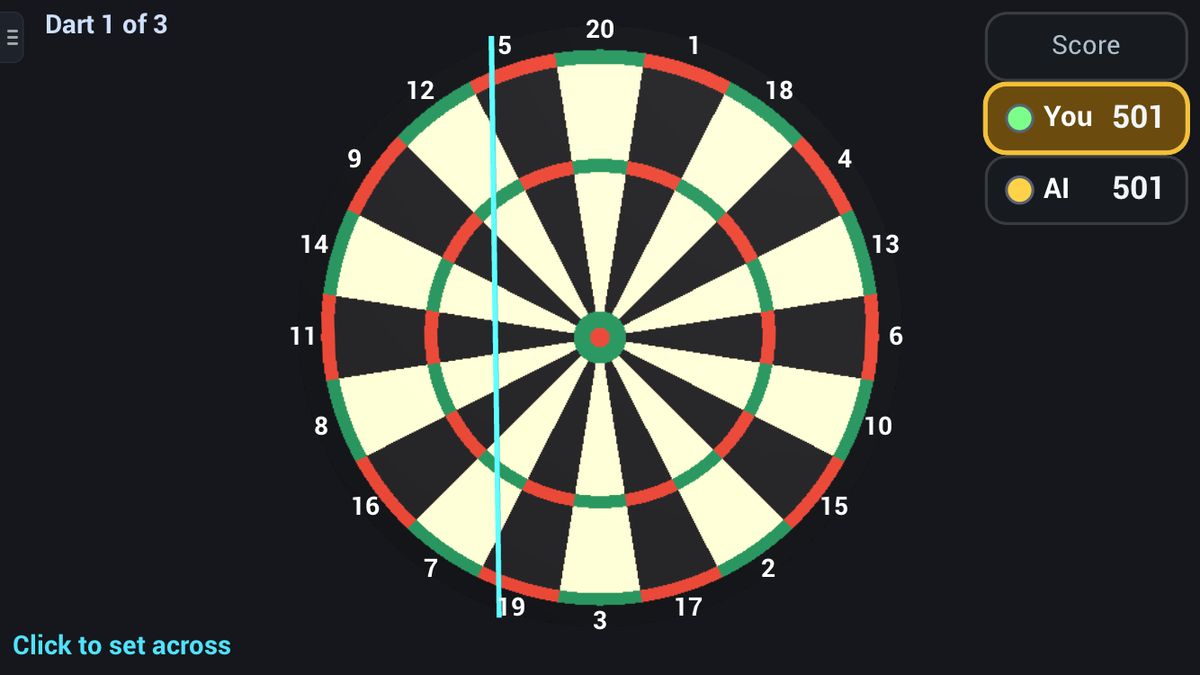
Real 501 on a 3D board, three darts a turn. The crosshair sweeps across the board — tap once to lock it left-to-right, tap again to lock it up-and-down, and the dart flies.
The outer ring doubles its sector and the inner ring trebles it; the bull counts as a double 25. Subtract every dart and check out on exactly zero with a double.
A dart that overshoots, leaves exactly 1, or reaches zero without a double BUSTS: the whole turn is wiped and your score reverts.
The aim
Darts 3D is the game of 501 on a dartboard. Both players start on 501, and every dart takes its score off your total. The first player to reach exactly zero, with the last dart in a double, wins.
How a turn works
You throw three darts a turn, then your rival throws. Each dart takes two taps.
- Lock the first line. A line sweeps from side to side across the board. Tap when it crosses the spot you want.
- Lock the second line. A line now sweeps up and down. Tap when it crosses your spot. The dart lands exactly where the two lines meet.
How the board scores:
- Each wedge scores its number, 1 to 20.
- The thin outer ring doubles the number, and the thin inner ring trebles it. Treble 20 is 60, the most one dart can score.
- The outer bull is 25 and the bullseye is 50. The bullseye counts as a double.
- A dart off the board scores nothing.
A small example. On 501, you hit treble 20, single 20 and single 5: 85 in all, leaving 416.
Scoring and the end of the game
To win, your last dart must bring you to exactly zero and land in the double ring or the bullseye. With 40 left, double 20 wins.
A dart busts if it takes you below zero, leaves exactly 1, or reaches zero without a double. A bust wipes out the whole turn: your score goes back to where it was, and your rival throws.
For example, you have 32. Your first dart hits single 16, leaving 16. Your second hits single 18, which would take you below zero. Bust: you start your next turn on 32 again.
The game ends the moment someone checks out, so there is always a winner.
Tips to play better
- The lines slow down at the edge. They move fastest across the middle and slow near the rim, turning back right on the double ring. For double 20, lock the side-to-side line through the middle, then tap the up-and-down line as it slows at the top.
- Score big while you are far away. Aim for treble 20. Treble 19 is a good change: it sits between 7 and 3, so a near miss costs less than beside the 20, between 1 and 5.
- Leave an even number. Doubles only make even numbers. With an odd score, throw a single odd number first.
- Pick finishes that forgive a miss. On 32, missing double 16 into single 16 leaves 16, which is double 8.
- See where you aimed. In the vs-computer setup, tick "Show where I aimed" to keep your locked cross on the board until the dart lands.
Common mistakes
- Throwing at treble 20 when you are close to finishing, and busting.
- Forgetting the double. Single 20 with 20 left is a bust, not a win.
- Leaving yourself on 1, which can never be finished.
- Tapping a moment late as a line crosses the middle, where it moves fastest.
Playing with family
Darts 3D needs no strength or steady hand, only timing, so a child can beat a grown-up. Counting down is easy subtraction practice, and planning the finish keeps older players thinking.
In Jambolaya you can play against the computer. Choose Easy, Normal or Hard, who throws first, and a single game or a best of 3 or 5. The computer aims for treble 20, then switches to doubles when it gets close. On Easy its darts scatter widely; on Hard they land much closer to its aim.
In the app you can also play together nearby, each on your own phone or tablet, with no Wi-Fi or internet needed. The browser edition plays on one device.
Ways to play
- Against the computerPlay on one device against a computer opponent.
- Play together, nearbyOne-on-one with someone in the same room, each on your own phone or tablet. No Wi-Fi or internet needed. In the Jambolaya app.
 Bowling 3D1–2 players
 Mini-Golf 3D1–2 players
 Cannon Battle1–2 players
 Star Strikers1–2 players
 Air Hockey1–2 players
 Carrom1–2 players
 Crokinole1–2 players
 Prism Rush1–4 players