 Jambolaya
Gin Rummy
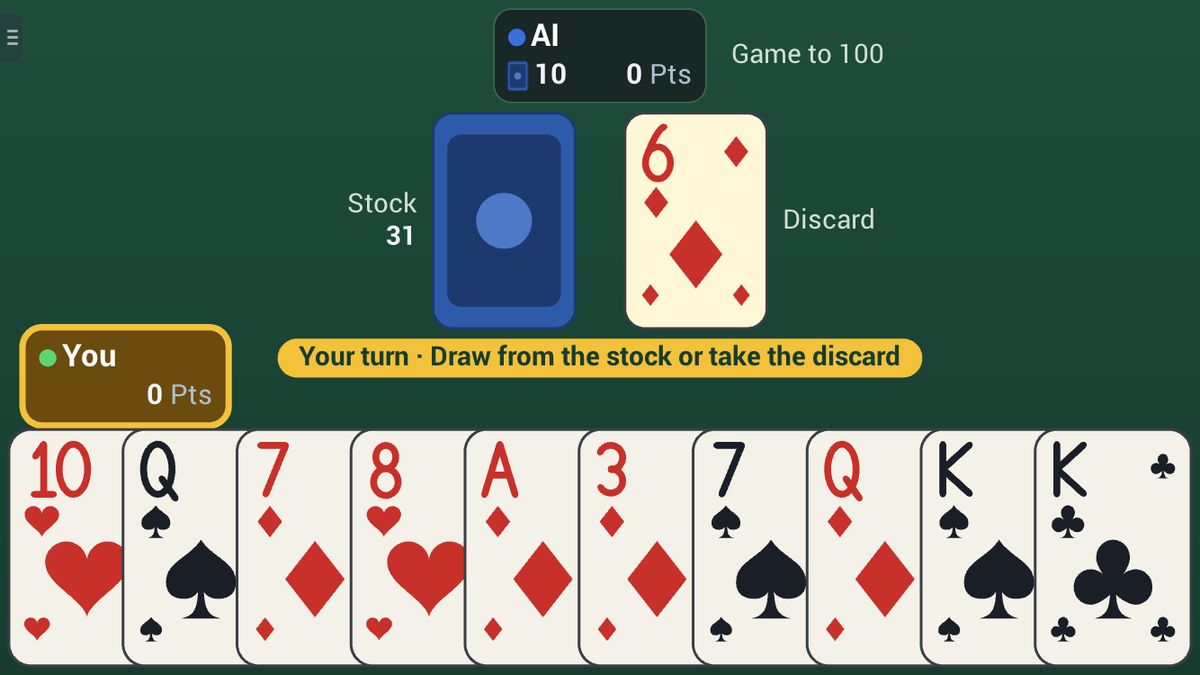
How to play
Draw and discard to build melds — runs of three or more cards in one suit, or sets of the same rank. When your unmatched cards (deadwood) total 10 points or fewer you may knock to end the hand; with no deadwood at all you go gin for a bonus.
Score the deadwood difference each hand; first to 100 points wins. Knocking is allowed by default; at a table set to Straight gin it is switched off, so a hand can only end on a gin.
The aim
Gin Rummy is for two players, and each gets 10 cards. You sort them into melds: three or four cards of the same rank, like three 8s, or three or more cards in a row of one suit, like the 4, 5 and 6 of clubs. Cards outside a meld are deadwood, and deadwood counts against you. Finish rounds with less deadwood than your opponent, and be first to 100 points.
How a turn works
One card is turned face up to start the discard pile. The rest is the face-down stock. The players take turns to start each new round.
- Draw. Take the top card of the stock or of the discard pile. You now hold 11 cards.
- Discard. Put one card face up on the discard pile to end your turn.
- Or knock. If one discard would leave 10 or fewer points of deadwood, the Knock button lights up. Tap Knock, then the card to throw away. The round ends.
Deadwood points: Ace 1, number cards their number, Jack, Queen and King 10. The Ace is always low, so Ace-2-3 is a run but Queen-King-Ace is not.
If your discard leaves no deadwood at all, that is gin, and the round ends at once.
A small example: you hold the 4, 5 and 6 of clubs, three 8s, the Jack, Queen and King of diamonds, and the 2 of spades. You draw the 3 of hearts. Throw it away and only the 2 of spades is left over. Your deadwood is 2, so you can knock, or keep going and hope for gin.
Scoring and the end of the game
When someone knocks, both hands are shown. The other player's loose cards that fit the knocker's melds are laid off onto them; the app does this for them in the best way. Then:
- Knock: the knocker scores the difference between the two deadwood counts.
- Undercut: if the other player's deadwood is the same or lower, they win the round and score the difference plus 25.
- Gin: the player who went gin scores the opponent's deadwood plus 25. Nothing can be laid off on a gin.
Two lines under the result explain the score. If a player wants to draw from the stock when only two cards are left in it, the round is a draw and nobody scores. Points add up, and the first to reach 100 wins. Only one player scores in a round, so there are no ties.
In setup you can choose Straight gin: no knocking, and only a gin ends a round.
Tips to play better
- Throw away lone high cards early. A loose King costs 10, a loose 2 only 2.
- Keep cards that fit two melds, like a 7 of hearts beside another 7 and the 8 of hearts.
- Watch what your opponent takes. If they took the 9 of diamonds, don't hand them an 8 or 10 of diamonds, or another 9.
- Knock as soon as you can early in a round. Waiting for gin gives your opponent time.
- Late in a round, knocking with high deadwood is risky: you may be undercut.
Common mistakes
- Planning a Queen-King-Ace run. The Ace only goes at the low end.
- Holding high cards too long, hoping they will form a meld.
- Forgetting that the deadwood shown while you hold 11 cards still includes the card you are about to throw away.
Playing with family
Gin Rummy is calm and quick to learn: draw one, throw one. Children practise adding small numbers, and you can drag cards sideways to keep each meld together.
Play against the computer at Easy, Normal or Hard. The guided lesson walks you through melds, deadwood, drawing, discarding and your first knock. In the app, two players can also play together nearby, each on their own phone or tablet, with no Wi-Fi or internet needed.
Ways to play
- Against the computerPlay on one device against a computer opponent.
- Play together, nearbyOne-on-one with someone in the same room, each on your own phone or tablet. No Wi-Fi or internet needed. In the Jambolaya app.
- Learn by playingA guided lesson on the real game teaches you the rules one step at a time.
 Crazy Eights1–6 players
 Go Fish1–4 players
 Hearts1–4 players
 President1–6 players
 Spades1–4 players
 Bridge1–4 players
 Sevens1–7 players
 Whist1–4 players