 Jambolaya
Sevens
How to play
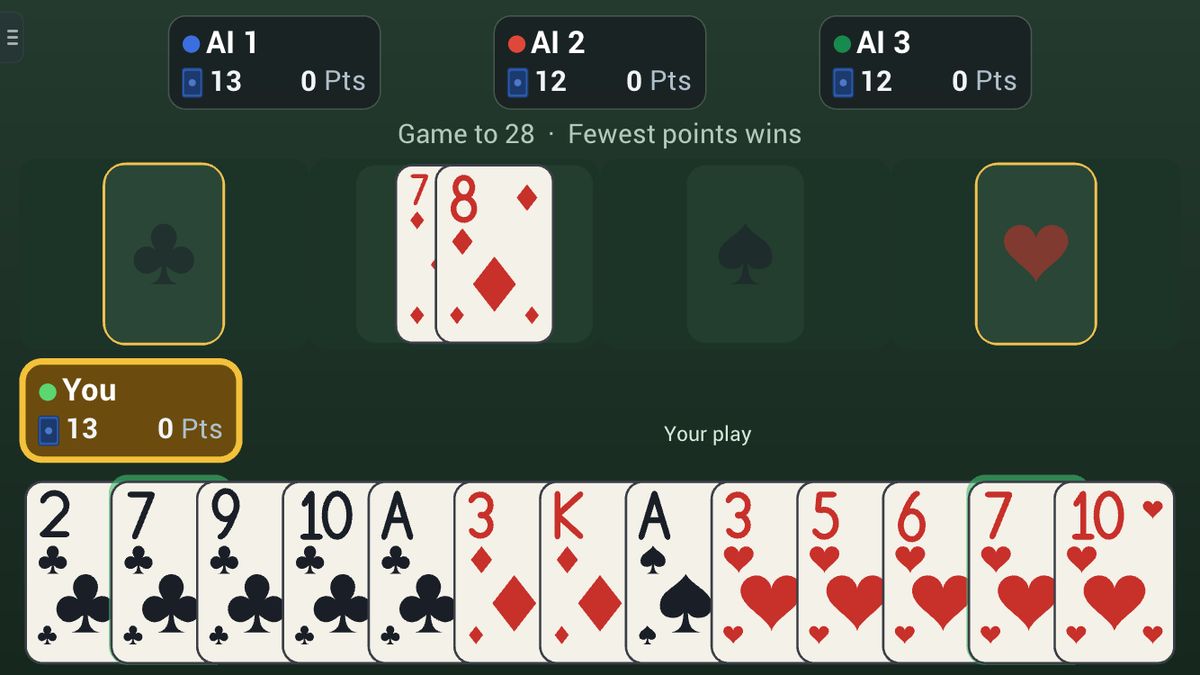
The whole deck is dealt out and whoever holds the 7♦ plays it to start. On your turn you build each suit up and down from its 7 — a suit's 7 must come first, then the 6 or 8, then 5 or 9, and so on out to the Ace and King.
You MUST play if you can; you only pass when you have no legal card (so holding your other 7s keeps those suits closed — that's how you block). The first player to empty their hand wins the hand; everyone else scores penalty points for the cards left.
When a player reaches the cap, the lowest total wins.
The aim
Sevens is a card game for 3 to 7 players. Together, everyone builds four rows on the table, one for each suit. Each row starts with its 7 and grows outward. You want to be the first to play every card in your hand. Cards still in your hand when someone else finishes count against you, so over several hands the player with the fewest points wins.
How a turn works
The whole deck is dealt. If it does not share out evenly, some players get one extra card, and that extra card moves around from hand to hand.
- The 7 of diamonds opens. Whoever holds it plays it first, every hand.
- Grow a row. On your turn, play one card that fits an open end. Beside a 7 only the 6 or the 8 of that suit fits. Beside the 6 only the 5, beside the 8 only the 9, and so on.
- Open a new row. A suit starts only when someone plays its 7. Until then, no other card of that suit can be played.
- Play if you can. If any card fits, you must play one. Only the cards that fit glow.
- Pass only when stuck. If nothing fits, tap Pass.
Each row runs down to the Ace and up to the King. In Jambolaya the Ace is low: it goes after the 2.
A small example: the diamond row runs from 5 to 9. You hold the 4 of diamonds, the 10 of diamonds and the 7 of clubs. All three glow. The 4 or the 10 grows the diamonds. The 7 of clubs opens a new row for everyone.
Scoring and the end of the game
A hand ends the moment one player plays their last card. That player scores nothing. Everyone else scores 1 penalty point for each card left in their hand.
Points add up over several hands. The game ends when anyone's total reaches the limit shown on the table as "Game to": 30 with three players, 28 with four, 25 with five, 22 with six and 19 with seven. The lowest total then wins. If two or more share the lowest total, it is a draw.
Tips to play better
- Hold back a 7 when you can play something else. While you keep it, that whole suit stays closed.
- But do not sit on a 7 when you hold many cards of its suit. You need that row open yourself.
- Prefer a card that lets you play your next one later. A 6 followed by your own 5 keeps you moving.
- Avoid cards that only help the next player. A 9 you play may free their 10.
- Watch the hand counts. Slow down the player who is closest to finishing.
Common mistakes
- Playing a 7 just because it glows, and opening a suit that helps everyone else.
- Thinking you may pass to keep a card. You may pass only when nothing fits.
- Forgetting that the Ace sits below the 2, not above the King.
Playing with family
Sevens is one of the gentlest card games for children. They only need to know the suits and the order of the cards, and the glowing cards show every legal move. Grandparents enjoy the quiet tactics of blocking with a 7. With up to seven players, the whole family fits at one table.
In Jambolaya you can play against the computer with 3 to 7 players, at Easy, Normal or Hard. The guided lesson lets you open with the 7 of diamonds, pass when stuck and grow a row with your own taps, then shows how a held 7 blocks a suit. In the app, 3 to 7 people can also play together nearby, each on their own phone or tablet, with no Wi-Fi or internet needed.
Ways to play
- Against the computerPlay on one device against a computer opponent.
- Play together, nearbyWith family and friends in the same room: up to 7 players, each on their own phone or tablet. No Wi-Fi or internet needed. In the Jambolaya app.
- Learn by playingA guided lesson on the real game teaches you the rules one step at a time.
 Whist1–4 players
 Knockout Whist1–7 players
 Oh Hell1–7 players
 Euchre1–4 players
 Sergeant Major1–3 players
 Ninety-Nine1–3 players
 Pinochle1–4 players
 War1–2 players