 Jambolaya

Lines of Action
How to play
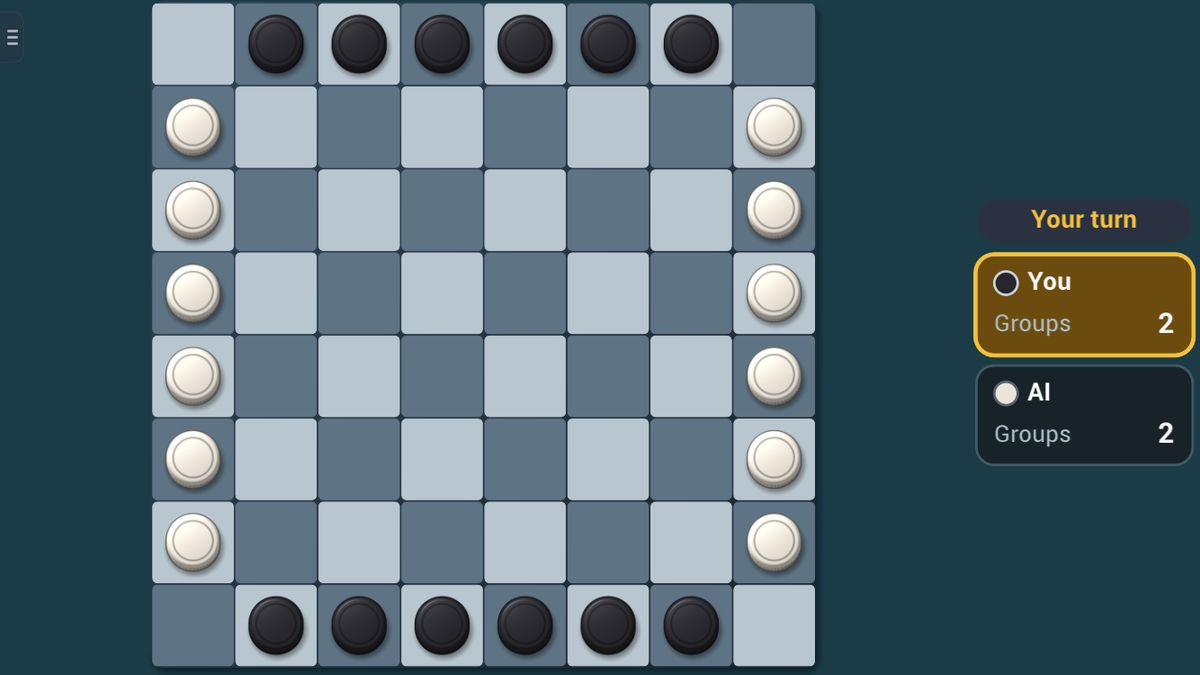
Your twelve checkers start along opposite edges. A checker moves in a straight line — horizontally, vertically, or diagonally — exactly as many squares as there are checkers of either colour anywhere on that whole line.
You may leap your own checkers but not the enemy's, and you may land on an enemy checker to capture it. The goal is to bring ALL of your remaining checkers into one connected group (touching orthogonally or diagonally); a lone checker counts as connected.
If a move connects both sides at once, the player who moved wins.
The aim
Lines of Action is played on an 8 by 8 board by Black and White, with twelve checkers each. Black's checkers start along the top and bottom edges, White's along the left and right edges, and the corners stay empty. Your goal is to bring all of your checkers together into one connected group. The first player to do it wins.
Checkers in a group touch side by side or corner to corner, in any shape at all.
How a turn works
Black always moves first. Against the computer, if you choose to start, you play Black.
- Tap one of your checkers, then one of the marked squares where it can go.
- A checker moves in a straight line: along its row, its column or a diagonal.
- It moves exactly as many squares as there are checkers on that whole line. Count both colours, and count the moving checker too.
- It may jump over your own checkers, but never over an enemy checker.
- It may not land on your own checker. Landing on an enemy checker captures it.
A small example. At the start, look at a black checker in the top row. Its column holds just two checkers, itself and the black one at the bottom, so along that column it moves exactly two squares down. Its row holds six checkers, and six squares would run off the board, so it cannot move along the row.
Distances keep changing, because every move changes how many checkers some lines hold.
Scoring and the end of the game
There are no points. After every move the game checks both players. If all your checkers form one group, you win. A single checker on its own also counts as a group, so capturing your opponent down to one checker makes them win.
If one move joins both players' groups at once, usually by a capture, the player who moved wins.
A player with no legal move is skipped, which almost never happens. After 300 moves in total with no winner, the game is a draw. Against the computer you can play a single game, or a best of 3 or 5.
Tips to play better
- Head for the middle. Checkers on the edges are far from everything. Bring them in towards the centre, where the group will form.
- Watch the Groups count. The app shows how many separate groups each player has. Fewer is better, and one is a win.
- Capture with care. Every capture leaves your opponent fewer checkers to join.
- Break their links. When your opponent is almost one group, capture the checker that holds two parts together.
- Block the path. Enemy checkers cannot jump yours, so a well-placed checker keeps a stray enemy away.
Common mistakes
- Counting only your own checkers on the line, or forgetting the moving checker itself.
- Capturing the one enemy checker that was stuck far away, which joins their group for them.
- Leaving one of your checkers stranded on an edge until the very end.
- Expecting to jump over an enemy checker. Enemy checkers always block.
Playing with family
The counting rule is a good little puzzle for children learning numbers, and the marked squares show every legal move once a checker is tapped. Older players enjoy the planning.
In Jambolaya you can play against the computer on Easy, Normal or Hard, and choose who starts. Easy sometimes plays a random move; Hard looks a few moves ahead. The guided lesson teaches the counting rule, jumping your own checkers and capturing, then shows a loss and lets you make the move that joins your group.
In the app you can also play together nearby, each on your own phone or tablet, with no Wi-Fi or internet needed. The browser edition plays on one device.
Ways to play
- Against the computerPlay on one device against a computer opponent.
- Play together, nearbyOne-on-one with someone in the same room, each on your own phone or tablet. No Wi-Fi or internet needed. In the Jambolaya app.
- Learn by playingA guided lesson on the real game teaches you the rules one step at a time.
 Order & Chaos1–2 players
 Connect61–2 players
 Royal Game of Ur1–2 players
 Fox & Geese1–2 players
 Kōnane1–2 players
 Brandub1–2 players
 Tablut1–2 players
 Triangles1–2 players