 Jambolaya

Royal Game of Ur
How to play
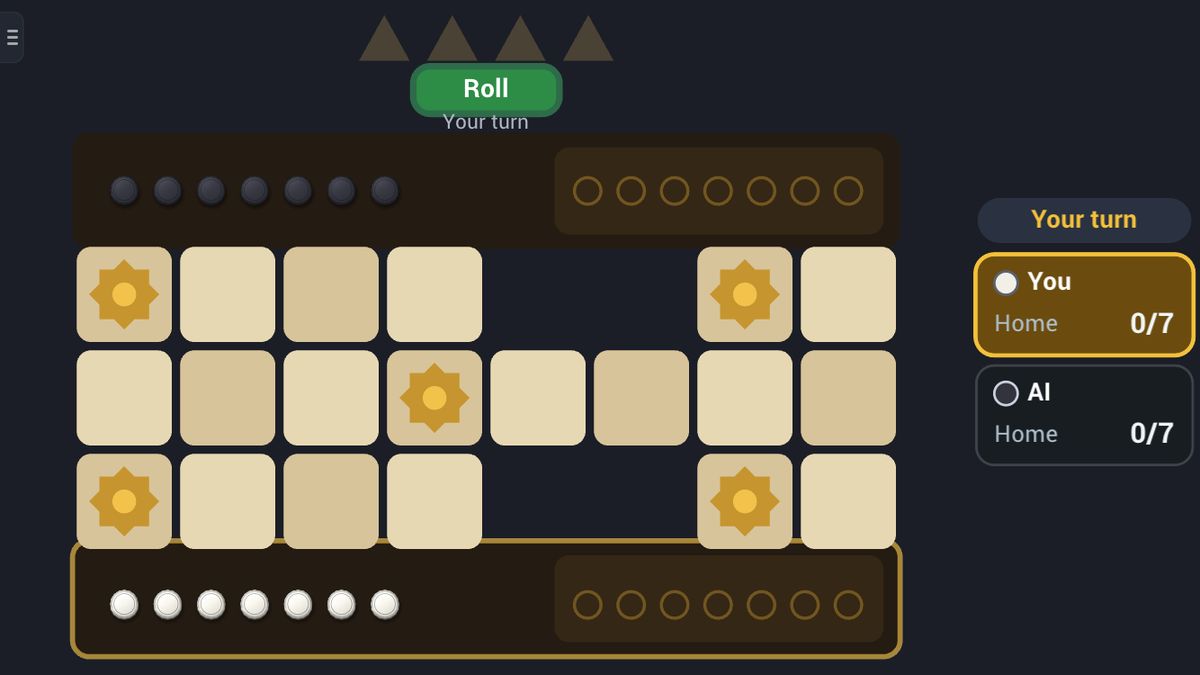
The 4,500-year-old Mesopotamian race game. Each side runs seven pieces along its track — up your own row, along the shared middle lane, and off the far end — and the first to bear off all seven wins.
Each turn you throw four binary dice for 0–4 pips (tap ROLL), then move one piece that far; a throw of 0 or one with no legal move passes the turn. Landing on an opponent's piece in the shared lane sends it back to start.
The five flowered ROSETTE squares are special: land on one and you throw again, and the central rosette is safe — a piece there can't be captured. Bearing a piece off needs an exact throw.
The aim
Two players, White and Black, each race seven pieces along a track of fourteen squares and then off the far end. The first four squares are your own private row. Next comes the shared middle row of eight squares, where the two sides meet and can knock each other back. Two more private squares lead home. The first player to carry all seven pieces off wins.
How a turn works
White moves first. Against the computer, choosing to start means you play White.
- Tap Roll to throw the four dice. Each lands marked or blank, and you move one square for each marked die, from 0 to 4.
- Tap one lit piece to move it that many squares: a new piece coming on, or one already on the track.
- You move one piece per turn, and you can never land on your own piece.
A throw of 0 loses your turn, and so does a throw with no legal move.
Five squares carry a flower, called a rosette: the fourth square of each private row, the last square of each home stretch, and one in the shared row. Land on any rosette and you roll again. The shared rosette is also safe. A piece there cannot be hit, and the other side cannot land on it.
In the shared row, landing on an enemy piece sends it back to the start.
Example: you have a piece on your first rosette and throw a 4. It jumps to the shared rosette. You are safe there, and you roll again.
Scoring and the end of the game
There are no points. A piece leaves the board only with the exact number: from the last square you need a 1, from the one before it a 2. A bigger throw cannot move that piece, so you move another one or lose the turn. The first player with all seven pieces off wins. There are no draws.
Against the computer you can play a single game, or a best of 3 or 5.
Tips to play better
- Two is the most common throw, and 0 and 4 are rare. Plan on ones, twos and threes.
- A throw of 4 brings a new piece straight onto your first rosette, and that means another roll.
- Count the danger behind you. In the shared row, any enemy piece one to four squares behind can hit you, even one still in its private row.
- Park a piece on the shared rosette and leave it there for a while. It is safe, and it blocks the other side's best square.
- Keep your pieces at different distances from the end, so more throws are useful when you bear off.
Common mistakes
- Rushing one piece through the shared row while enemy pieces wait right behind it.
- Leaving several pieces near the end that all need the same exact number.
- Forgetting that your own pieces block each other, so a good throw has nowhere to go.
- Leaving the shared rosette early just because that piece is furthest ahead.
Playing with family
A turn is quick: roll, then tap one piece. Luck matters, so a young child can beat an adult, but the choices are real, and older players soon start counting the squares between their pieces and the enemy.
In Jambolaya you can play against the computer on Easy, Normal or Hard. Easy often picks a careless move. The guided lesson covers rolling, rosettes, hitting, the exact throw and a lost turn on 0, then shows a loss and lets you finish a win.
In the app, two players can also play together nearby, each on their own phone or tablet, with no Wi-Fi or internet needed. The browser edition plays on one device.
Ways to play
- Against the computerPlay on one device against a computer opponent.
- Play together, nearbyOne-on-one with someone in the same room, each on your own phone or tablet. No Wi-Fi or internet needed. In the Jambolaya app.
- Learn by playingA guided lesson on the real game teaches you the rules one step at a time.
 Fox & Geese1–2 players
 Kōnane1–2 players
 Brandub1–2 players
 Tablut1–2 players
 Triangles1–2 players
 Fanorona1–2 players
 Pig1–4 players
 Farkle1–6 players