 Jambolaya
Nonogram
How to play
The numbers beside each row and column give the lengths of the filled runs, in order. Use them to work out which cells are filled and which are blank, revealing a hidden picture. First to solve it wins.
The aim
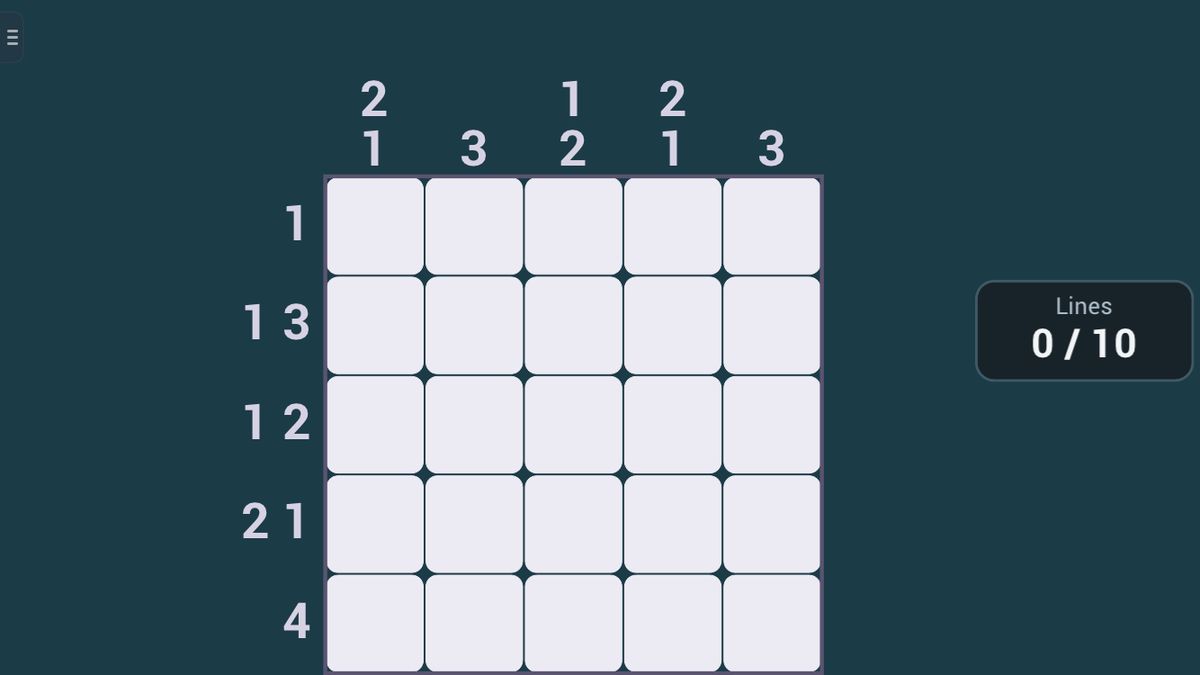
Nonogram gives you an empty grid, five squares across and five down, with numbers beside each row and above each column. Fill the right squares so that every row and every column matches its numbers. When they all match, a small hidden pattern stands complete.
How to solve it
There are no turns. Tap a square to fill it dark. Tap it again to make it blank. Mistakes cost nothing.
The numbers are clues. Each number is a block of filled squares side by side. Blocks come in the order given, left to right for a row and top to bottom for a column, and there is at least one blank square between two blocks. A row marked 3 has one block of three somewhere in it. A row marked 1 2 has a single square, then a gap, then two squares together. A 0 means the whole line stays blank.
When a line matches its clue, the clue turns green. The Lines count shows how many of the ten clues are green.
An example: a row's clue is 2 2. Two blocks of two, plus one gap between them, take exactly five squares, the whole width of the grid. So the row must be filled, filled, blank, filled, filled. Fill it in, then check each column with those four squares in place.
Each new game deals a fresh pattern. There is no level to choose.
Scoring and the end of the game
There are no points. The puzzle is solved the moment all ten clues are green; any filling that fits every clue counts.
Alone, no clock pushes you. When you solve the grid, the app tells you how many seconds you took. Tap New game for another pattern.
In a race, both players get the identical puzzle. You see a bar of how many lines your rival has solved, never their squares. The first to turn every clue green wins. If you finish moments apart, the faster time wins; exactly the same time is a draw.
Tips to play better
- Start with the sure lines. A 5 fills the whole line. A 0 leaves the whole line blank.
- Add up the clue. Add the blocks, plus one for each gap between them. If the total is 5, as with 1 3, 3 1, 2 2 or 1 1 1, there is only one way to place it.
- Use the overlap. However you slide a 4 along five squares, it always covers the middle three. A 3 always covers the middle square. Fill those first.
- Cross-check. Each time you settle a row, look down every column it crosses.
- Fill only when sure. The app has no mark for "surely blank", so keep those squares in your head and leave them empty.
Common mistakes
- Forgetting the gap. A clue of 1 1 means two single squares apart from each other, never two squares touching.
- Ignoring the order. 1 3 is not the same as 3 1. In 1 3, the single square comes first.
- Trusting one green clue. A row can turn green with its block in the wrong place. If a column refuses to fit, check the green rows that cross it.
Playing with family
Nonogram needs no reading, only numbers up to five and a little patience. The grid is small enough for a child to finish, and quick enough for several races in a row with a grandparent.
The guided lesson shows how to read a clue, fill a block, check a square against both its row and its column, and clear a square with a second tap.
There is no computer opponent. Play alone, or, in the app, race together nearby, each on your own phone or tablet, with no Wi-Fi or internet needed. The browser edition is for one device.
Ways to play
- On your ownPlay alone, whenever you like.
- Play together, nearbyOne-on-one with someone in the same room, each on your own phone or tablet. No Wi-Fi or internet needed. In the Jambolaya app.
- Learn by playingA guided lesson on the real game teaches you the rules one step at a time.
 Word Duel1–2 players
 Letter Storm1–2 players
 Word Grid1–4 players
 Crate Push1–2 players
 Shape Swap1–2 players
 Letter Ring1–4 players
 Star Battle1–4 players
 Lot Slide1–4 players