 Jambolaya
Oh Hell
How to play
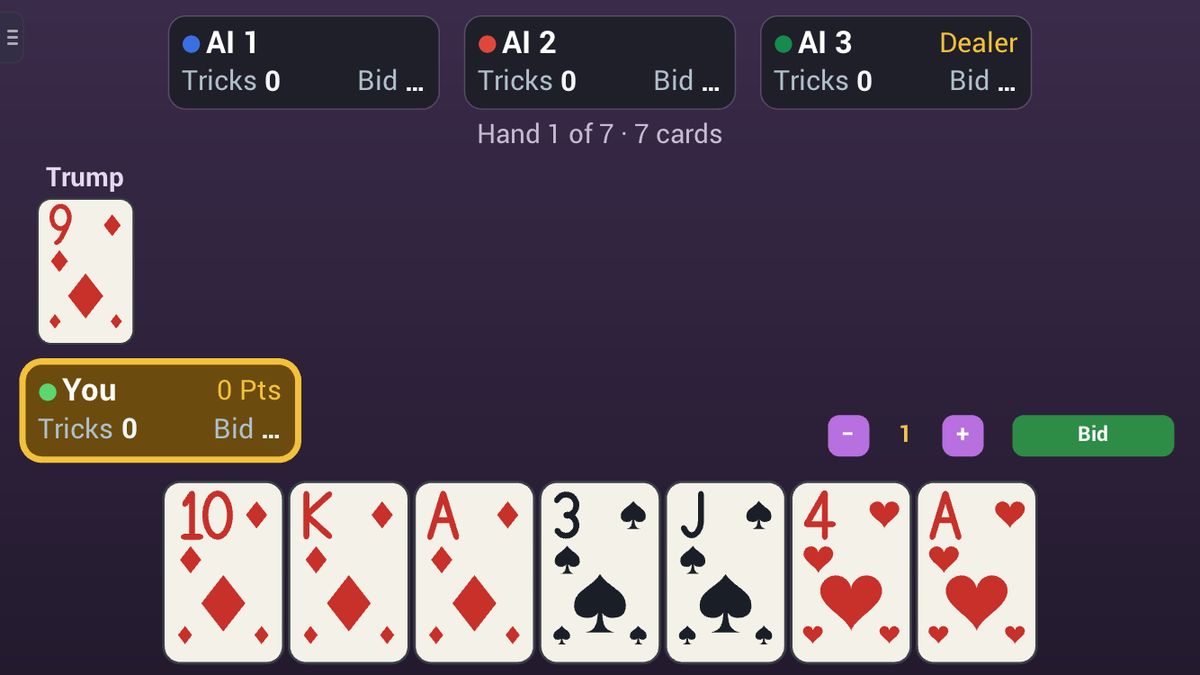
Three to seven players, no partners — the match is exactly seven hands of 7, 6, 5, 4, 3, 2 and finally 1 card each. Each hand the next stock card is turned up and its suit is trump.
Starting left of the dealer, everyone bids how many tricks they'll take (0 up to the hand size) — but the dealer, bidding last, may NOT bid the number that would make the bids add up to the hand size, so someone must fail every hand.
Follow the led suit if you can; the highest trump wins the trick, or the highest card of the led suit. You score only by landing EXACTLY on your bid — 10 + bid points; anything else scores nothing, so an overtrick is as bad as a shortfall.
Highest total after hand seven wins.
The aim
Oh Hell is about making a promise and keeping it. At the start of every hand you say how many tricks you will win. Win exactly that many and you score; one more or one fewer scores nothing. After seven hands, the most points wins.
How a turn works
Three to seven people play, each for themselves. The game is always seven hands: 7 cards each in the first, then 6, then 5, down to just 1 card in the last. After the deal, the next card of the stock is turned face up. Its suit is trump for that hand.
- Bid. Starting left of the dealer, everyone says how many tricks they expect to win, from zero up to the number of cards in hand. Set your bid with − and +, then press Bid.
- The dealer's catch. The dealer bids last and may not pick the number that would make all the bids add up to the number of cards. So the bids never fit, and somebody always misses.
- Play the tricks. The player left of the dealer leads any card. Everyone else plays one card in turn. If you have the suit that was led, you must play it. If not, play anything, even a trump.
- Who takes it. The highest trump wins the trick. With no trump in it, the highest card of the led suit wins. The winner leads next.
Aces are high and 2s are low. Only cards you may play glow.
A small example: five cards each, and hearts are trump. You hold the Ace of spades, the King of hearts, the 9 of clubs and two small diamonds. The Ace and the King look like winners, so you bid 2. Someone leads a diamond: you must follow with a small one, and it loses, as planned. When spades are led, your Ace wins, unless a player with no spades plays a heart.
Scoring and the end of the game
Each player who won exactly their bid scores 10 points plus the bid. Bid 3 and take 3: 13 points. Bid zero and take nothing: 10 points. Miss by any amount and you score nothing for that hand.
After the seventh hand, the one-card hand, the highest total wins. If players share the top score, the game is a draw.
Tips to play better
- A zero bid is worth 10 points. With low cards and no trumps, it is often the best call.
- Count your sure winners: high trumps, aces, and kings with a smaller card of the same suit beside them.
- Add up everyone's bids. If the total is lower than the number of tricks, spare tricks are left over and players will try to dump them. If it is higher, tricks will be fought over.
- Once your bid is made, play the highest card that still loses. An extra trick costs you everything.
- In the tiny hands at the end, one trump decides a lot. Look at the turned-up card before you bid.
Common mistakes
- Bidding what you hope to win instead of what you can really win.
- Forgetting that too many tricks scores nothing, just like too few.
- Leading your aces after your bid is made, and winning tricks you did not want.
Playing with family
Everyone plays every trick, and a careful child can beat a bold grown-up by guessing well. The tiny hands at the end are quick and exciting.
In Jambolaya you can play against the computer at Easy, Normal or Hard, with three to seven at the table. A guided lesson lets you bid, lead and follow suit with your own taps. In the app, three to seven people can also play together nearby, each on their own phone or tablet, with no Wi-Fi or internet needed.
Ways to play
- Against the computerPlay on one device against a computer opponent.
- Play together, nearbyWith family and friends in the same room: up to 7 players, each on their own phone or tablet. No Wi-Fi or internet needed. In the Jambolaya app.
- Learn by playingA guided lesson on the real game teaches you the rules one step at a time.
 Euchre1–4 players
 Sergeant Major1–3 players
 Ninety-Nine1–3 players
 Pinochle1–4 players
 War1–2 players
 Old Maid1–6 players
 Briscola1–4 players
 Cheat1–6 players