 Jambolaya
Pattern Flash
How to play
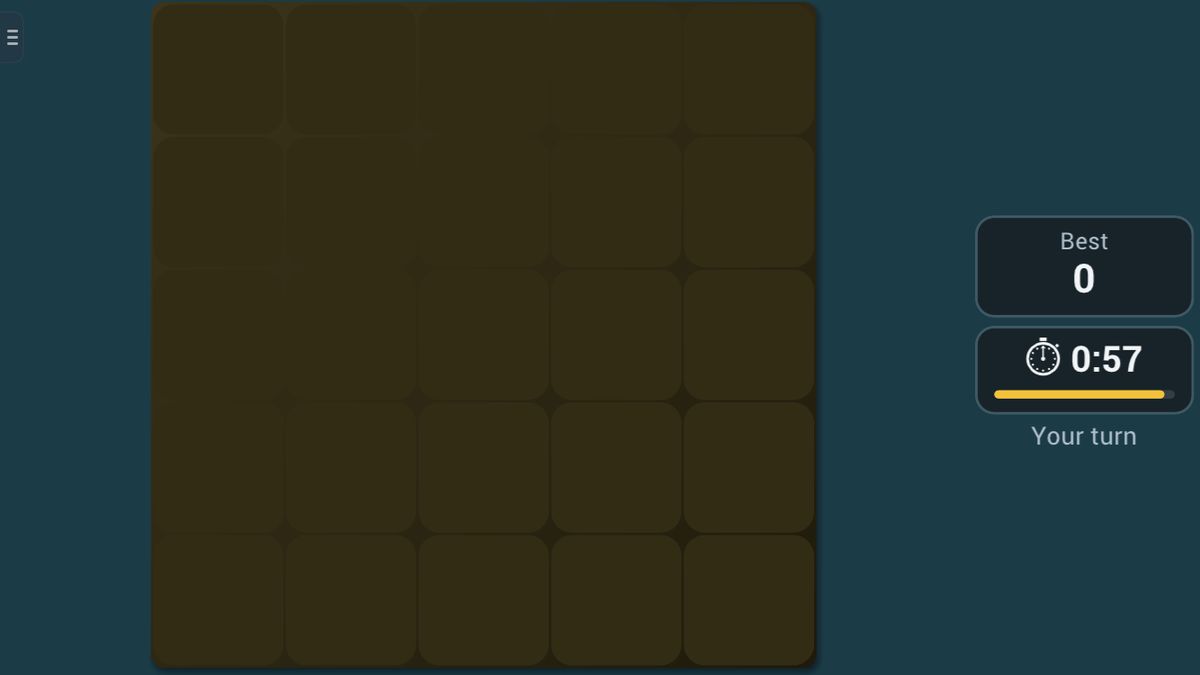
A set of cells lights up for a moment, then hides. Reproduce the pattern by tapping the cells that were lit. Each clean reproduction adds one cell; a wrong tap resets the current chain. Your score is the longest pattern you reproduce before time runs out.
The aim
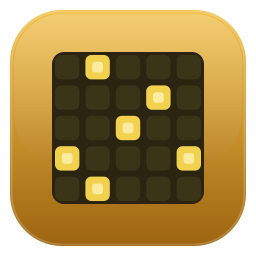
In Pattern Flash, a few squares on a grid light up gold for a moment, then go dark. You tap the squares that were lit. Each time you get the whole pattern right, the next one has one more square. Your aim is to remember the biggest pattern you can before the clock runs out.
How to play
There are no turns. You play at your own pace until time is up.
- Watch. Some squares glow gold. You cannot tap while they show.
- The lights go out. Tap every square that was lit, in any order.
- Each right square turns green.
- When every lit square is green, the next pattern has one more square.
- Tap a square that was not lit, and it turns red. The real pattern glows again for a moment so you see what you missed, and the next pattern goes back to the starting size.
An example on Normal: the top-left corner and the two squares below it light up. You tap all three and they turn green. Next come four squares. Your fourth tap lands one square too far right. It flashes red, and the next pattern has three squares again.
Before you start, choose the Difficulty:
- Easy: a 4×4 grid, starting with 2 squares, lit for about 2 seconds.
- Normal: a 5×5 grid, starting with 3 squares, lit for about 1.4 seconds.
- Hard: a 6×6 grid, starting with 4 squares, lit for about 1 second.
The lights stay on just as long however big the pattern gets, so a long pattern gives you less time per square. Patterns stop growing at 12 squares.
Scoring and the end of the round
Your score, shown as Best, is the longest pattern you have tapped back in the round. A wrong tap never lowers it, but it costs time, because you have to build back up.
Alone, you choose a round of 1, 3 or 5 minutes. In a race, the round lasts 60 seconds, both players start from the same patterns, and the player who invites picks the level. You see your rival's score, but not their grid, since that would give the answer away. When the clock runs out, the higher score wins. Equal scores are a draw.
Tips to play better
- See a shape, not dots. Join the lit squares in your mind: an L, a line, a corner, a zigzag. One shape is easier to hold than five spots.
- Use landmarks. "Top-right corner, then two down" is easy to find again.
- Tap the sure ones first. Any order counts, so start with the squares you are certain of.
- Count while you look. If you know there are six squares, you know when one is still missing.
- Take in the whole grid during the flash. Staring at one square makes you miss the far side.
Common mistakes
- Tapping fast to get it over with. Only the round is timed, not each pattern. Take a breath before the last square.
- Guessing wildly. One wrong tap sends you back to the start. If unsure, pick the square that best fits your shape.
- Holding one big shape. At seven or eight squares, split the pattern into two smaller shapes.
Playing with family
Pattern Flash needs no reading and no numbers, only eyes and memory, so children often do very well at it. Easy, with its small grid and longer look, is a gentle start.
The guided lesson plays a real round on Normal. Three squares light up and the coach rings them so you can tap them back. Then it shows how the pattern grows and how your score is counted.
There is no computer opponent. Play alone, or, in the app, race one other player together nearby, each on your own phone or tablet, with no Wi-Fi or internet needed. The browser edition plays on a single device.
Ways to play
- On your ownPlay alone, whenever you like.
- Play together, nearbyOne-on-one with someone in the same room, each on your own phone or tablet. No Wi-Fi or internet needed. In the Jambolaya app.
- Learn by playingA guided lesson on the real game teaches you the rules one step at a time.
 Number Hunt1–2 players
 Alphabet Run1–2 players
 Mirror Mates1–2 players
 Letter Trace1–2 players
 Flip Check1–2 players
 Sound Hunt1–2 players
 Sound Chain1–2 players
 Look, Cover, Build1–2 players