 Jambolaya

Pig
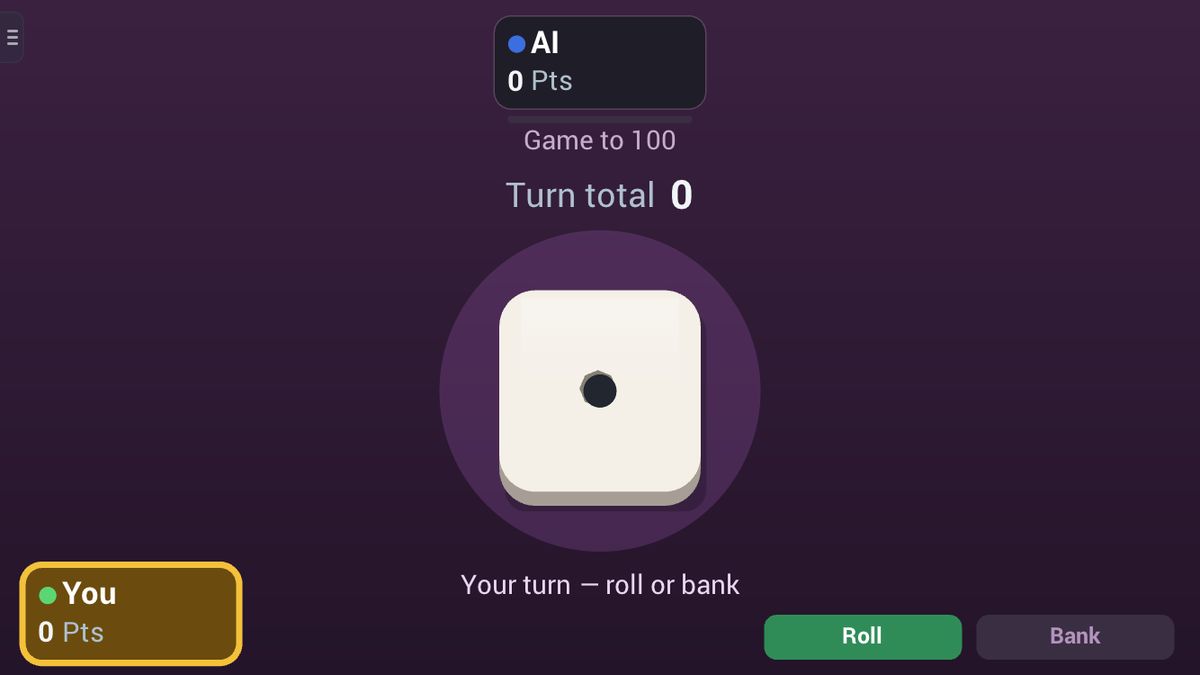
How to play
Two to four players race to 100. On your turn you roll one die again and again — each roll adds its number to your turn total, which is at risk until you bank it. But roll a 1 and you lose the whole turn total and your turn ends (your banked score is safe).
At any point you may bank instead of rolling: your turn total is added to your permanent score and play passes on. It's a push-your-luck game — the more you roll the more you can score, but the bigger the pile you'll lose to a 1.
The first player to reach 100 points wins.
The aim
Pig is a race to 100 points with a single die, for two to four players. On your turn you roll as often as you dare, and every roll adds up. But a 1 wipes out everything you rolled that turn. The trick is knowing when to stop and keep what you have. The first player to bank 100 points or more wins.
How a turn works
Your turn has two numbers on screen: your score, which is safe, and your turn total, which is not.
- Tap Roll. If the die shows 2, 3, 4, 5 or 6, that number joins your turn total.
- Now choose: roll again to make the turn total grow, or tap Bank.
- Bank adds your turn total to your score, where it stays for good. Your turn ends.
- If you roll a 1, your turn total drops to nothing and your turn ends at once. Your score is not touched.
You must roll at least once. Bank lights up only when there is something to bank.
A small example. You roll a 5, then a 4. Your turn total is 9. You roll again and get a 6, so now it is 15. Feeling brave, you roll once more and see a 1. All 15 points are gone, and the turn passes on. If you had tapped Bank at 15, those points would be yours forever.
Scoring and the end of the game
Only banked points count. The game ends the moment a player banks and their score reaches 100 or more. That player wins right away, and the others do not get a last turn. A turn total that passes 100 does not win until you tap Bank, so a 1 can still take it away.
Because the game stops as soon as someone gets there, there is never a tie.
Tips to play better
- Bank at about 20. Each roll has a one-in-six chance of a 1. The other faces add 4 on average. Once about 20 points are at risk, one more roll costs more than it brings, on average.
- Bank as soon as it wins. If your score plus your turn total reaches 100, tap Bank. One more roll can only lose it.
- Push harder when you are behind. If someone is close to 100, small safe banks will not catch them. Take bigger risks.
- Play it safe when you are far ahead. Smaller banks make it hard for the others to catch up.
- Watch the leader in a big game. With three or four players, the one to worry about is whoever is nearest 100.
Common mistakes
- Rolling "just once more" with a big turn total, again and again, until a 1 arrives.
- Banking tiny totals like 3 or 4 every turn. It is safe, but far too slow to win.
- Thinking that a turn total is already part of your score.
- Rolling past 100 in one turn and forgetting to bank it.
Playing with family
Pig takes one minute to learn. You only need to add small numbers, so it is good practice for young children. A grandparent's careful play and a child's wild luck both have their day.
In Jambolaya you can play against the computer. Choose two, three or four players, meaning you and up to three computer opponents. Then choose Easy, Normal or Hard. You roll first. On Easy the computer banks early and not always wisely. On Hard it plays close to the "bank at about 20" rule. The guided lesson lets you roll until a 1 takes it all, then bank safely, then shows a loss and lets you bank the winning points.
In the app, two to four players can also play together nearby, each on their own phone or tablet, with no Wi-Fi or internet needed. The browser edition plays on one device.
Ways to play
- Against the computerPlay on one device against a computer opponent.
- Play together, nearbyWith family and friends in the same room: up to 4 players, each on their own phone or tablet. No Wi-Fi or internet needed. In the Jambolaya app.
- Learn by playingA guided lesson on the real game teaches you the rules one step at a time.
 Farkle1–6 players
 Shut the Box1–4 players
 Liar's Dice1–6 players
 Dominoes1–4 players
 Reversi1–2 players
 Four-in-a-Row1–2 players
 Five-in-a-Row1–2 players
 Tic-Tac-Toe1–2 players