 Jambolaya
Rummy 500
How to play
The scoring cousin of Rummy: EVERY card you put on the table earns points, so you play for the melds, not just to go out. Two to seven can play.
You're dealt thirteen cards in the two-player game — a table may shorten that to seven or ten — and seven cards each with three or more; from five players up, two decks are shuffled together.
Each turn: draw the face-down stock, or take the top of the discard pile — either is always allowed. Or DIG: take any card further down the discard pile, provided you also take every card above it and meld the card you dug for at once — the rest join your hand.
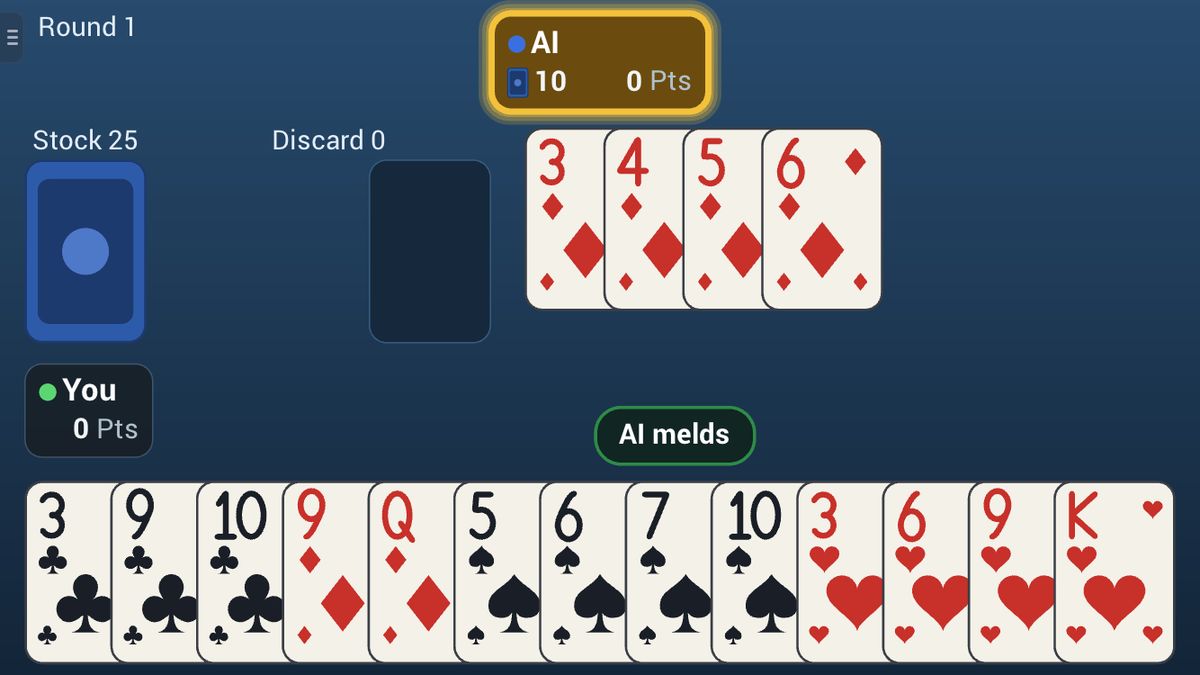
Then lay down SETS (3–4 of a rank, each a different suit) and RUNS (3+ in a suit in sequence — an ace plays low or high, A-2-3 or Q-K-A, but never round the corner), and lay cards off onto any table meld, yours or an opponent's.
Finish by discarding one card, or go out by emptying your hand. The card you just took off the discard pile cannot go straight back the same turn, unless it is the only one left in your hand.
When the round ends, each player scores the value of the cards THEY tabled (Ace 15 — but only 1 in an A-2-3 run, faces and tens 10, others face value) minus the value of the cards left in their hand — a round can go negative.
First to the cumulative target — 500 by default, or the 250 or 1000 a table picks — ends the game; the highest total wins.
If the stock runs out, the discard pile, all but its top card, is shuffled into a new stock — at most twice a round; the third time, the round ends and is scored as usual.
A table may also add two JOKERS (54 cards): a joker is wild and stands for whichever card you name when you lay it down — that choice is fixed for the rest of the round — and it scores 15 wherever it lies.
The aim
Rummy 500 is Rummy where every card you lay on the table earns points for you, and cards left in your hand count against you. When someone reaches 500, the highest total wins.
How a turn works
Rummy 500 is for 2 to 7 players. With two, each gets 13 cards (a table may choose 7 or 10 instead); with three or more, 7. From five players up, two decks are shuffled together. The face-up pile is spread out, so you can see every card in it.
- Take a card from the top of the face-down pile or the face-up pile. Either is always allowed.
- Or dig. Take a card deeper in the face-up pile, with every card above it. The card you dug for must go on the table at once, in a new meld or on one already there. The rest join your hand.
- Meld and lay off. A set is 3 or 4 cards of one rank, each a different suit. A run is 3 or more of one suit in order. An Ace may be low (A-2-3) or high (Q-K-A), but not both, so K-A-2 is not a run. Cards you add to any meld, even another player's, score for you.
- Discard one card, or go out by emptying your hand. You can't throw back the top card you just took, unless it is your last. After a dig you may throw away any card.
A small example: the Ace of clubs is fourth from the top of the face-up pile, and you hold the Queen and King of clubs. Dig for the Ace and lay down Q-K-A at once. The three cards above it come into your hand.
Scoring and the end of the game
A round ends when someone goes out. If the face-down pile runs out, the face-up pile (all but its top card) becomes a new one, but only twice; the third time, the round ends.
Then everybody scores the cards they put on the table, minus the cards still in their hand. Aces are 15, but an Ace in an A-2-3 run counts 1. Kings, Queens, Jacks and 10s are 10; the rest are their number. A round score can be below zero.
The game ends when someone reaches 500 (a table may pick 250 or 1000), and the highest total wins. If players are tied at the top, another round is played.
A table may also add two jokers. A joker is wild: when you lay it down you choose which card it stands for, and it stays that card for the round. It is worth 15 wherever it lies, in your hand too.
Tips to play better
- Lay off on other players' melds. Those points are yours.
- Don't sit on Aces you can't use. Each costs 15 when the round ends.
- Dig only when it pays. Every card above comes into your hand and counts against you until you play it.
- Going out ends the round for everyone. When you are ahead, go out quickly to catch others with full hands.
Common mistakes
- Holding cards back as in plain Rummy. Here every card on the table is points.
- Trying to meld K-A-2. An Ace is high or low, never in the middle.
- Digging deep for one card and getting stuck with a hand full of high cards.
Playing with family
With room for seven, Rummy 500 suits a big family, and children practise adding as scores grow.
In Jambolaya you can play against the computer with 2 to 7 players, at Easy, Normal or Hard, and choose the target, the jokers and the two-player deal. A guided lesson covers melds, scoring, lay-offs, digging, the Ace and the jokers. In the app, up to seven people can also play together nearby, each on their own phone or tablet, with no Wi-Fi or internet needed.
Ways to play
- Against the computerPlay on one device against a computer opponent.
- Play together, nearbyWith family and friends in the same room: up to 7 players, each on their own phone or tablet. No Wi-Fi or internet needed. In the Jambolaya app.
- Learn by playingA guided lesson on the real game teaches you the rules one step at a time.
 Manipulation Rummy1–5 players
 Palace1–4 players
 Slapjack1–4 players
 Spit1–2 players
 Spite & Malice1–2 players
 Gin Rummy1–2 players
 Crazy Eights1–6 players
 Go Fish1–4 players