 Jambolaya
Snakes & Ladders
How to play
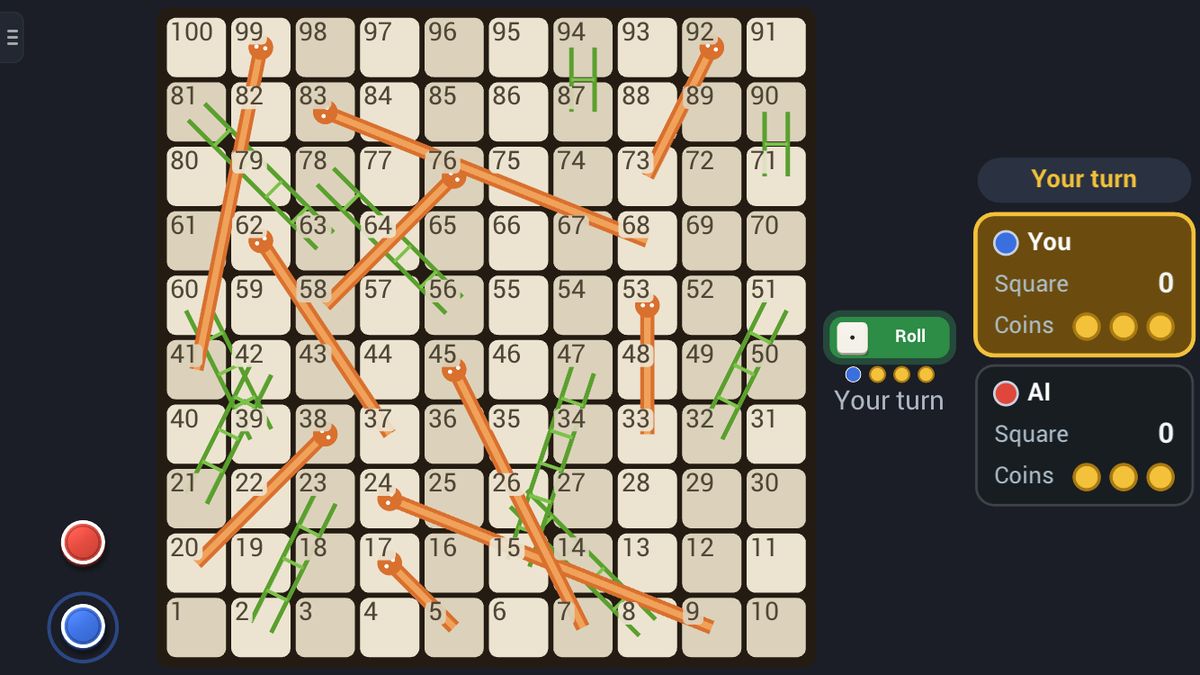
Two to four players each race one token up a hundred-square board. Your turn is a single die roll — a six earns no extra throw. Land on the foot of a ladder and you climb to its top; land on the head of a snake and you slide down to its tail.
No top or tail ever feeds another jump, so nothing chains. Every player starts with three nudge coins.
After a roll you may spend one to move one square more or one fewer — you are asked only when it matters: when the roll lands on a snake's head, or when a nudge would reach a ladder's foot or exactly 100. A nudge never takes you onto a snake.
A snake bite gives one coin back, up to three. You must reach 100 EXACTLY: a roll that would overshoot leaves you where you stand. The first token home wins.
The aim
Two to four players each move one token up a board of 100 squares. Ladders carry you up, snakes send you down, and the first token to land exactly on 100 wins. Jambolaya adds a twist: nudge coins.
How a turn works
Everyone starts before square 1, with three nudge coins.
- Tap Roll to throw one die, and your token walks that many squares.
- Land on the foot of a ladder and you climb to its top. Land on a snake's head and you slide down to its tail.
- One roll per turn. Even a 6 hands the turn on.
- Tokens never block or capture each other.
No ladder top or snake tail leads onto another snake or ladder, so jumps never chain.
Nudge coins. After a roll you may spend a coin to move one square more or one fewer. You are asked only when it matters: when your roll lands on a snake's head, or when a nudge would reach a ladder's foot or exactly 100. A nudge never takes you onto a snake. When asked, tap the die to move as rolled, or tap +1 or -1 to spend a coin; each choice shows the square it ends on. Your coins are the gold dots under Roll.
Each snake bite gives one coin back, but you never hold more than three.
Example: you are on 35 and roll a 3. That is the snake at 38, which drops you to 20. Spend a coin to move one more, and you land on the ladder at 39 instead, which carries you up to 60.
Scoring and the end of the game
There are no points. You must reach 100 exactly; a roll that would go past it leaves your token where it is. A nudge can help: on 97, a 4 is one too many, but a coin moves you one fewer, onto 100. The first token on 100 wins at once, so there are no ties.
Tips to play better
- Save a coin for the end. The snake on 99 drops you all the way to 41. A coin in your pocket lets you step around it.
- Spend coins on the long slides. The snakes on 45 and 99 are the biggest drops on the board, so dodging them is worth far more than dodging a short one.
- A bite is not all bad. It gives a coin back, so a short slide can refill your purse for the dangerous squares near the top.
- Not every ladder is worth a coin. The ladder at 87 only climbs to 94, so you may rather keep the coin for the finish.
Common mistakes
- Using all three coins early, then meeting the snake on 99 with an empty purse.
- Forgetting that you need 100 exactly, and expecting a big roll to win.
- Thinking a 6 earns another roll.
Playing with family
Snakes & Ladders is often a child's first board game, because counting squares is all you need to start. The coins give older players real decisions, and a careful child can win by saving one at the right moment.
In Jambolaya you can play against the computer with two, three or four players on Easy, Normal or Hard, or let friends share one device and pass it round. The level decides how well the computer uses its coins: Easy picks at random, while Hard knows when a coin is worth more saved. The guided lesson shows ladders and snakes, a coin dodging a snake, the coin you get back, the exact finish, a loss, and a win you deliver yourself.
In the app, two to four players can also play together nearby, each on their own phone or tablet, with no Wi-Fi or internet needed. The browser edition plays on one device.
Ways to play
- Against the computerPlay on one device against a computer opponent.
- Play together, nearbyWith family and friends in the same room: up to 4 players, each on their own phone or tablet. No Wi-Fi or internet needed. In the Jambolaya app.
- Learn by playingA guided lesson on the real game teaches you the rules one step at a time.
 Chinese Checkers1–6 players
 Chinese Chess1–2 players
 Jungle Chess1–2 players
 Blob Spread1–4 players
 Halma1–4 players
 Yacht1–4 players
 Cascade1–4 players
 Breakthrough1–2 players