 Jambolaya
Halma
How to play
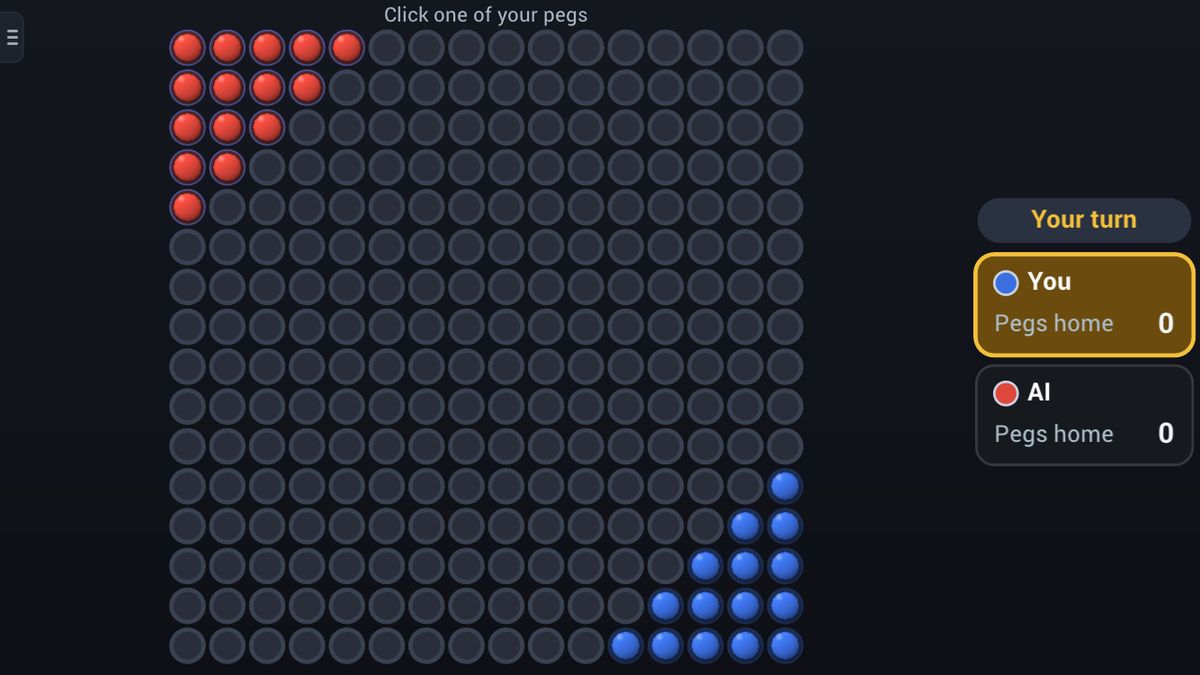
Move all your pieces from your corner camp into the camp diagonally opposite.
On your turn either step a piece to any of the eight neighbouring empty squares, or hop it over a touching piece (yours or anyone's) into the empty square beyond — and chain as many hops as you can. The first player to fill the opposite camp wins.
The aim
Halma is a race across a big square board of 16 by 16 squares. Each player starts with 15 pieces packed into a triangle in one corner, called their camp. Your goal is to move all of them into the camp in the corner diagonally opposite. The first player to fill that camp wins. With two players you swap corners; with four, every corner has a player and the paths cross in the middle.
How a turn works
On your turn you move one piece. Tap it, and the squares it can reach light up. Then tap one of them. A move is either a step or a hop, never both.
- Step: move to any of the eight squares touching the piece, sideways, up, down or slanting, if it is empty.
- Hop: jump over a touching piece, yours or anyone's, into the empty square straight beyond it.
- After a hop you may hop again from where you landed, in any direction, as many times as you can. You may stop after any hop.
Nothing is ever captured. The pieces you hop over stay where they are.
A small example. Your piece has a red piece right beside it, with an empty square behind. You hop over the red piece. Where you land, one of your own pieces stands beside you with another empty square behind it, so you hop again. Two hops carry the piece four squares in one move. A step only gets it one.
Scoring and the end of the game
There are no points. The first player whose target camp is completely filled wins, and the game ends. The Pegs home count shows how many of each player's pieces have arrived.
If an opponent leaves a piece sitting in your target camp, it cannot spoil your win. The camp counts as full once every square in it is taken, as long as some of the pieces are yours.
Traditional Halma gives each player 19 or 13 pieces, depending on the number of players. Jambolaya gives everyone 15.
Tips to play better
- Build ladders. Pieces in a line with one empty square between each one let your others hop a long way.
- Use everyone's pieces. An opponent's piece is just as good to hop over as your own.
- Leave no stragglers. A last piece far behind has nothing left to hop over and crawls home one step at a time.
- Fill the deep corner first. Pieces that stop at the edge of the target camp block the way for the ones behind.
- Mind what you build. Your ladder can carry an opponent's pieces just as well as yours.
Common mistakes
- Racing one piece far ahead alone, where it has nothing to hop over.
- Crowding the entrance of the target camp so your own pieces block each other.
Playing with family
There is no luck and nothing is ever lost, so a small child can play happily to the end. Four players can share one big race.
Against the computer, choose two or four players and Easy, Normal or Hard. You play Blue, and the computer plays every other colour. With Pass & Play, two or four people take turns on one device. With Show jump path on, a longer hop first draws its route; tap the square again to make it. The guided lesson teaches the step, a double hop, and ladders, then shows a loss and lets you move your last piece home to win.
In the app you can also play together nearby, up to four players, each on your own phone or tablet, with no Wi-Fi or internet needed. The browser edition plays on one device.
Ways to play
- Against the computerPlay on one device against a computer opponent.
- Play together, nearbyWith family and friends in the same room: up to 4 players, each on their own phone or tablet. No Wi-Fi or internet needed. In the Jambolaya app.
- Learn by playingA guided lesson on the real game teaches you the rules one step at a time.
 Yacht1–4 players
 Cascade1–4 players
 Breakthrough1–2 players
 Lines of Action1–2 players
 Order & Chaos1–2 players
 Connect61–2 players
 Royal Game of Ur1–2 players
 Fox & Geese1–2 players