 Jambolaya
Checkers
How to play
Move your pieces one square diagonally forward. Capture by jumping over an adjacent enemy piece to the empty square beyond; chain multiple jumps in one turn when you can. A piece that reaches the far row becomes a King and may also move and jump backward.
Capture all the opponent's pieces, or leave them with no move, to win.Variants (pick one in the setup): Pool checkers — pieces also capture backward, and Kings fly: a King moves any number of free squares along a diagonal and captures a piece from afar, landing on any free square beyond it.
Jumped pieces leave the board only when the whole capture is over, and a piece is crowned only if its move ends on the far row.
Russian draughts — as Pool checkers, but a piece that reaches the far row during a capture is crowned at once and keeps capturing as a King.
International draughts — as Pool checkers on a board of 10 by 10 squares with 20 pieces each, and you must make the capture that takes the most pieces.
A variant also has a draw rule, picked in the setup: the 25-move rule (a draw after 25 moves each in which only Kings moved and nothing was captured), draw offers (on your turn you may offer a draw; your opponent accepts or plays on), or none.
The aim
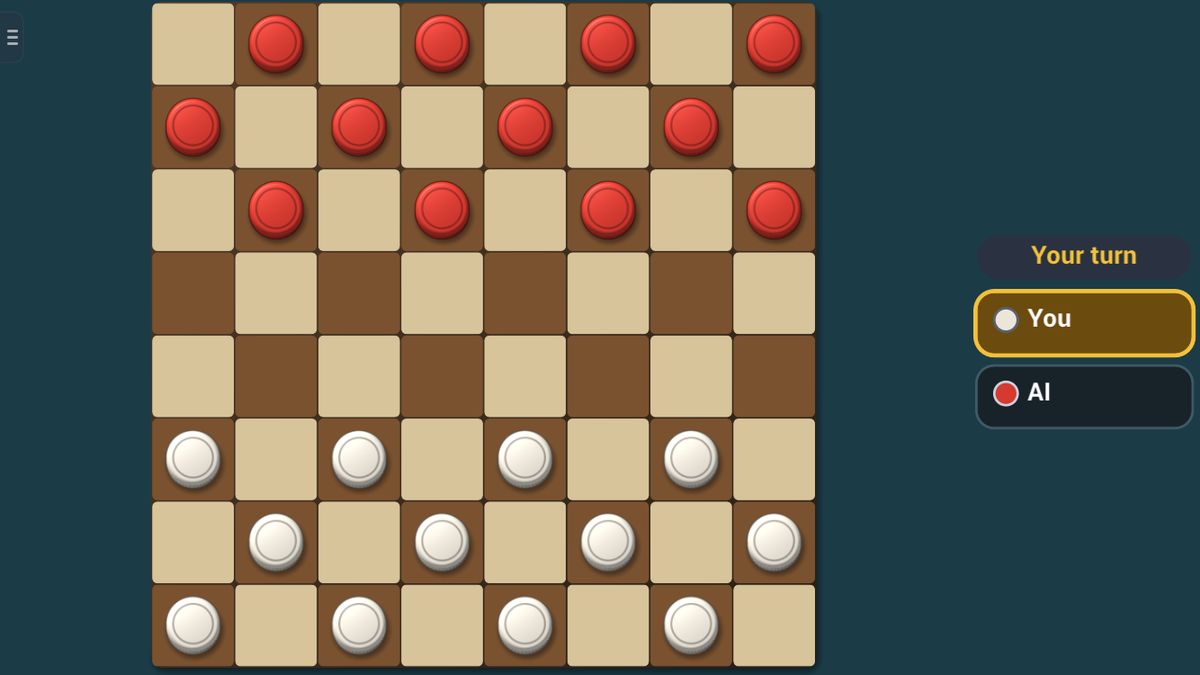
Checkers is played on the dark squares of an 8 by 8 board. Each player starts with 12 pieces on the three rows nearest them: White at the bottom, Red at the top. Capture all of your opponent's pieces, or leave them with no move, to win.
How a turn works
White moves first in Jambolaya. (Many traditional rulebooks start with the darker side.) Tap one of your pieces, then a lit square.
- A step. A piece moves one square diagonally forward, onto an empty square.
- A jump. If an enemy piece sits diagonally in front of yours, with an empty square right behind it, jump over it. The jumped piece leaves the board.
- Jumping is a must. If any of your pieces can jump, you have to jump. When several jumps are possible, you choose which one.
- Keep going. If the same piece can jump again after landing, it must, all in the same turn.
- Kings. A piece that reaches the far row becomes a King and wears a ring. A King moves and jumps one square at a time, forward or backward. If a piece is crowned in the middle of a jump, its turn ends there.
Example: a red piece steps next to yours, with an empty square behind it. You must jump it, and then Red may be forced to jump you straight back.
Scoring and the end of the game
There are no points. You win when your opponent has no pieces left, or none of them can move on their turn. The English game has no draw rule: if neither side can win, start a new game.
The setup screen also has a Rules choice with three more ways to play:
- Pool checkers. Pieces step only forward but may jump backward too. Kings fly: they slide any distance along a free diagonal, and jump a piece far away, landing on any free square beyond it. Jumped pieces stay, faded, until the capture ends. A piece is crowned only if its move ends on the far row.
- Russian draughts. Like Pool, but a piece reaching the far row mid-capture is crowned at once and keeps capturing as a King.
- International draughts. Like Pool on a 10 by 10 board with 20 pieces each, and you must make the capture that takes the most pieces.
These three also have a Draw rule: the 25-move king rule (a draw after 25 moves each with only Kings moving and no captures), draw offers, or none.
Tips to play better
- Keep your back row filled. While it is full, your opponent cannot crown a King.
- Use the must-jump rule: give up one piece so your opponent's forced jump lets you take two back.
- A piece on the side edge cannot be jumped at all, because there is no square behind it. But it has only one way forward.
- Move in pairs. A piece with a friend right behind it cannot be jumped from the front.
Common mistakes
- Missing a forced jump and wondering why a piece will not move. When a jump is possible, only a piece that can jump will answer your tap.
- Stepping next to an enemy piece with an empty square behind your own piece.
- Emptying your back row early, which lets your opponent crown Kings.
Playing with family
Checkers has two moves to learn and a lifetime of tricks. Only legal moves are lit, so a young player never breaks the must-jump rule by accident.
In Jambolaya you can play against the computer at Easy, Normal or Hard, choose who starts first, and play one game or best of 3 or 5. There are four guided lessons: the full English game, then one short lesson per variant. In the app, two players can also play together nearby, each on their own phone or tablet, with no Wi-Fi or internet needed.
Ways to play
- Against the computerPlay on one device against a computer opponent.
- Play together, nearbyOne-on-one with someone in the same room, each on your own phone or tablet. No Wi-Fi or internet needed. In the Jambolaya app.
- Learn by playingA guided lesson on the real game teaches you the rules one step at a time.
 Chess1–2 players
 Dots & Boxes1–2 players
 Ship Battle1–2 players
 Backgammon1–2 players
 Mancala1–2 players
 Nine Men's Morris1–2 players
 Hex1–2 players
 Go1–2 players