 Jambolaya

Five-in-a-Row
How to play
Take turns placing a stone on an empty point. The first to make an unbroken line of five of their stones — horizontally, vertically, or diagonally — wins.
The aim
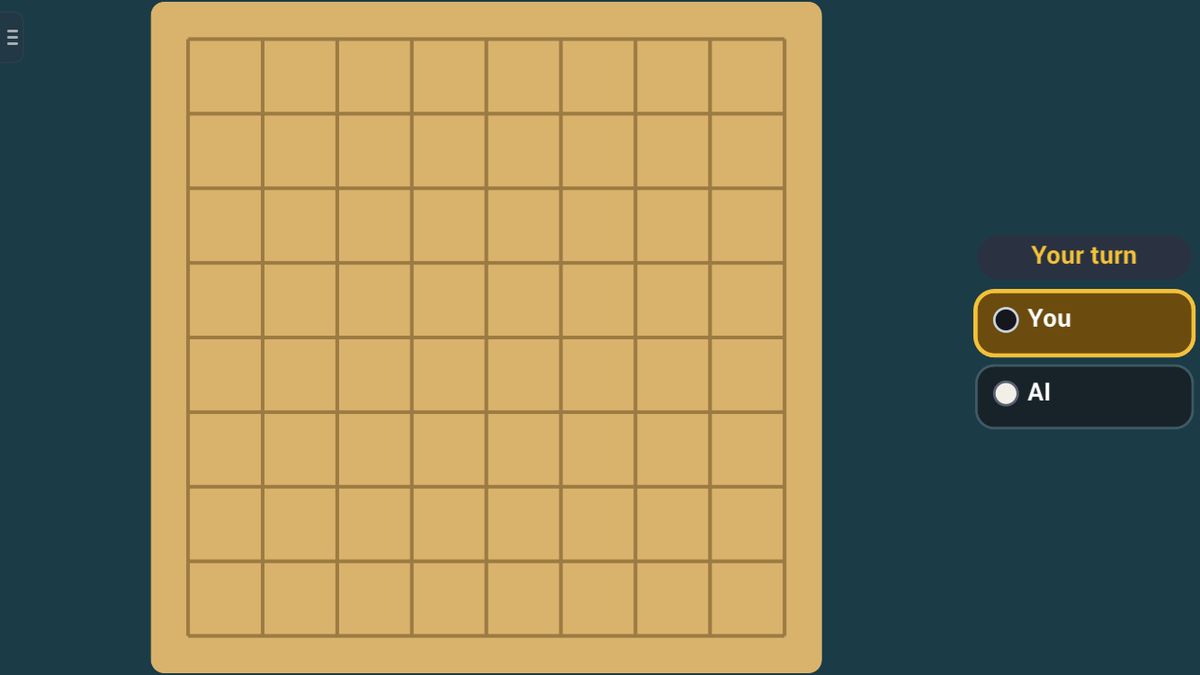
Five-in-a-Row is played on a grid of lines, and the stones go on the crossings. Black and White take turns placing one stone each. Stones never move and are never captured. The first player to make an unbroken line of five of their own stones wins. The line can run across, up and down, or slanting.
How a turn works
Black places the first stone. On your turn, tap any empty crossing and your stone goes there. That is the whole turn. There is no capturing and no passing.
A small example. Black starts near the middle. White answers close by. Black adds a stone right next to the first one: two in a row. White places a stone at one end of that pair. That end is now capped, so Black's line can only grow the other way.
Two ideas matter more than anything else:
- Open four: four in a row with both ends empty. Your opponent can block only one end, so you win at the other.
- Open three: three in a row with both ends empty. Leave it alone for one turn and it becomes an open four.
Scoring and the end of the game
There are no points. The game ends the moment someone makes five in a line, and that player wins. In Jambolaya a line of six or more also wins, and Black has no forbidden moves, as some stricter rules have.
If every crossing fills up with no line of five, the game is a draw. That is rare.
You can play on a 13 by 13 board, the default, or a smaller 9 by 9 board for quicker games. (The traditional board is bigger still, 15 by 15.)
Tips to play better
- Start near the centre. A stone in the middle can grow in every direction. A stone by the edge cannot.
- Block every open three at once. If you wait, it becomes an open four, and then it is too late.
- Block a four straight away. Even with one end capped, a four needs only one more stone.
- Make two threats with one stone. A stone that makes a four in one direction and an open three in another cannot be answered. Your opponent blocks one, you win with the other.
- Defend and attack together. When you must block, choose the blocking point that also lengthens one of your own lines.
Common mistakes
- Watching your own line so closely that you miss your opponent's slanting three.
- Building a line that is capped at both ends. It can never reach five, however long it gets.
- Placing stones far away from the action, where they block nothing and build nothing.
- Relaxing after blocking a three. It can still grow to four at its free end, and that four must be blocked too.
Playing with family
The rule is short enough for a young child, and five in a row is easy to see on the board. Older players enjoy planning double threats several moves ahead. The 9 by 9 board is a friendly place to start.
Against the computer, choose Easy, Normal or Hard, choose who starts (if you start, you are Black), the board size, and a single game or a best of 3 or 5. Easy often makes careless moves, which suits a beginner. The guided lesson, on the 9 by 9 board, has you start in the centre and build a pair. It shows a capped line and then a loss to White's open four. You finish by completing your own open four.
In the app you can also play together nearby, each on your own phone or tablet, with no Wi-Fi or internet needed. The browser edition plays on one device.
Ways to play
- Against the computerPlay on one device against a computer opponent.
- Play together, nearbyOne-on-one with someone in the same room, each on your own phone or tablet. No Wi-Fi or internet needed. In the Jambolaya app.
- Learn by playingA guided lesson on the real game teaches you the rules one step at a time.
 Tic-Tac-Toe1–2 players
 Checkers1–2 players
 Chess1–2 players
 Dots & Boxes1–2 players
 Ship Battle1–2 players
 Backgammon1–2 players
 Mancala1–2 players
 Nine Men's Morris1–2 players