 Jambolaya
Dominoes
How to play
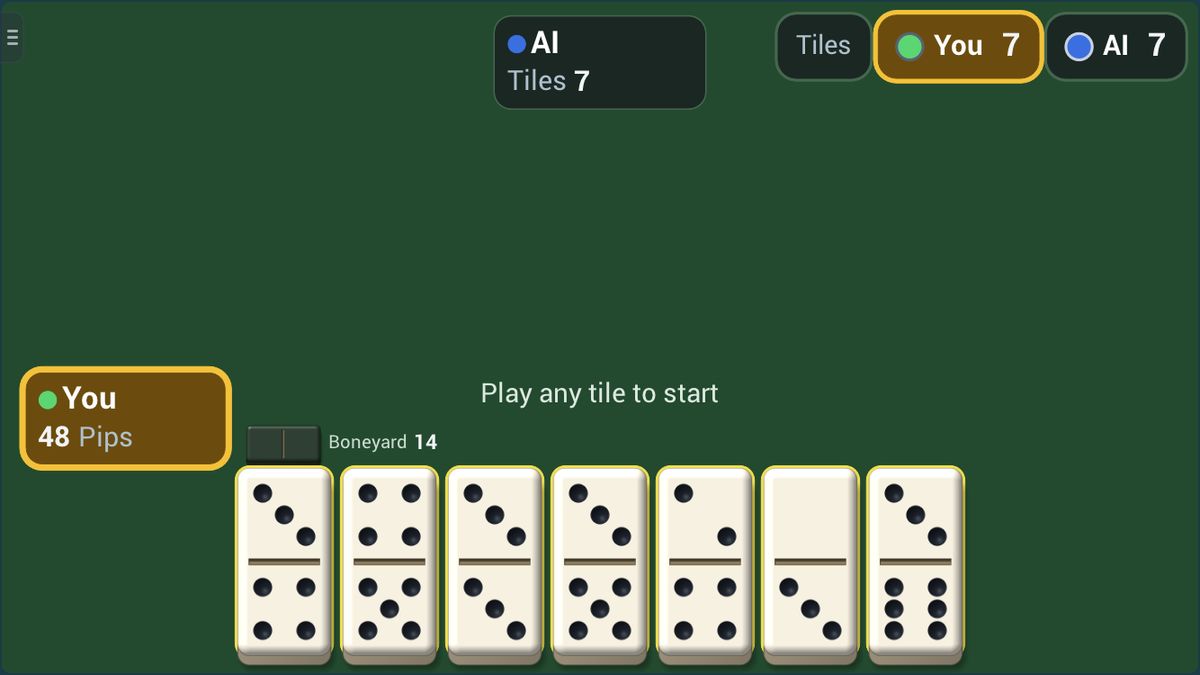
Match an open end of the layout with a tile from your hand bearing the same number and place it. If you can't, draw from the boneyard, or pass when it's empty. Play all your tiles first to win the round; if the game blocks, the lowest pip-count wins.
With the Spinner choice, the first double played becomes the spinner: once tiles touch both of its sides, its top and bottom open as well, and the line has four open ends.
The aim
Jambolaya uses a double-six set: 28 tiles, each with two ends showing from zero to six dots. Together the players build one line of tiles across the table. Be the first to lay down every tile in your hand.
How a turn works
With two players, each gets 7 tiles. With three or four, each gets 5. The spare tiles lie face down in the boneyard.
The first player may start with any tile. After that, the line has two open ends.
- Play a tile. Lay one tile against an open end that shows the same number. Tiles that fit are raised a little in your hand. If a tile fits both ends, tap the end where you want it.
- Draw. If nothing in your hand fits, tap the boneyard or Draw to take one tile. Keep drawing until you get one that fits, then play it.
- Pass. If nothing fits and the boneyard is empty, press Pass.
You may only draw when you cannot play.
A small example: the line shows a 3 on the left and a 5 on the right. You hold 3-6, 1-1 and 2-4. Only the 3-6 fits. Lay its 3 against the left end, and now the left end shows a 6. A double, like 6-6, keeps the same number showing at its end.
The Spinner choice. Before the game you can pick Classic (two ends) or Spinner. With Spinner, the first double laid becomes the spinner. Once tiles touch both of its sides, its top and bottom open too. Now the line has four open ends.
Scoring and the end of the game
The game ends as soon as one player lays down their last tile. That player wins.
If every player passes in a row, with the boneyard empty, the game is blocked. Then everyone counts the dots on the tiles still in their hand, and the player with the fewest dots wins. If the lowest counts are equal, the game is a draw.
In Jambolaya one game is one hand. (Many tables add up points over several hands; the app does not.) Against the computer you can play a single game or the best of three or five.
Tips to play better
- Play heavy tiles early. Tiles like 6-5 and 6-6 cost you a lot if the game blocks.
- Get rid of doubles while you can. A double fits only one number, so it is the hardest tile to place later.
- Keep variety. Holding several different numbers gives you more ways to match whatever ends appear.
- Watch when your rival draws. If they had to draw while a 4 was showing, they had no 4s. Leave a 4 showing.
- Count the tiles. Each number appears on seven tiles. When most of the 5s are already on the table, a 5 at an end is hard to match.
Common mistakes
- Playing whatever fits first, and getting stuck later with a hand of big doubles.
- Forgetting the other end of the line. Always check both ends, and with Spinner, the top and bottom too.
- Leaving an end showing a number you have just run out of, when another choice would keep you in the game.
Playing with family
Dominoes is a good first game for young children. Matching dots is simple, and counting them practises numbers. Only tiles that fit can be played, so nobody makes an illegal move.
In Jambolaya you can play one-on-one against the computer on Easy, Normal or Hard, and choose who starts. There are two guided lessons: one for matching, drawing, passing and winning, and a short one for the Spinner. In the app, two to four people can also play together nearby, each on their own phone or tablet, with no Wi-Fi or internet needed.
Ways to play
- Against the computerPlay on one device against a computer opponent.
- Play together, nearbyWith family and friends in the same room: up to 4 players, each on their own phone or tablet. No Wi-Fi or internet needed. In the Jambolaya app.
- Learn by playingA guided lesson on the real game teaches you the rules one step at a time.
 Reversi1–2 players
 Four-in-a-Row1–2 players
 Five-in-a-Row1–2 players
 Tic-Tac-Toe1–2 players
 Checkers1–2 players
 Chess1–2 players
 Dots & Boxes1–2 players
 Ship Battle1–2 players