 Jambolaya
Tile Slide
How to play
Slide tiles into the single empty space to rearrange them, working every numbered tile into order with the empty space ending in the corner. First to solve the shared puzzle wins.
The aim
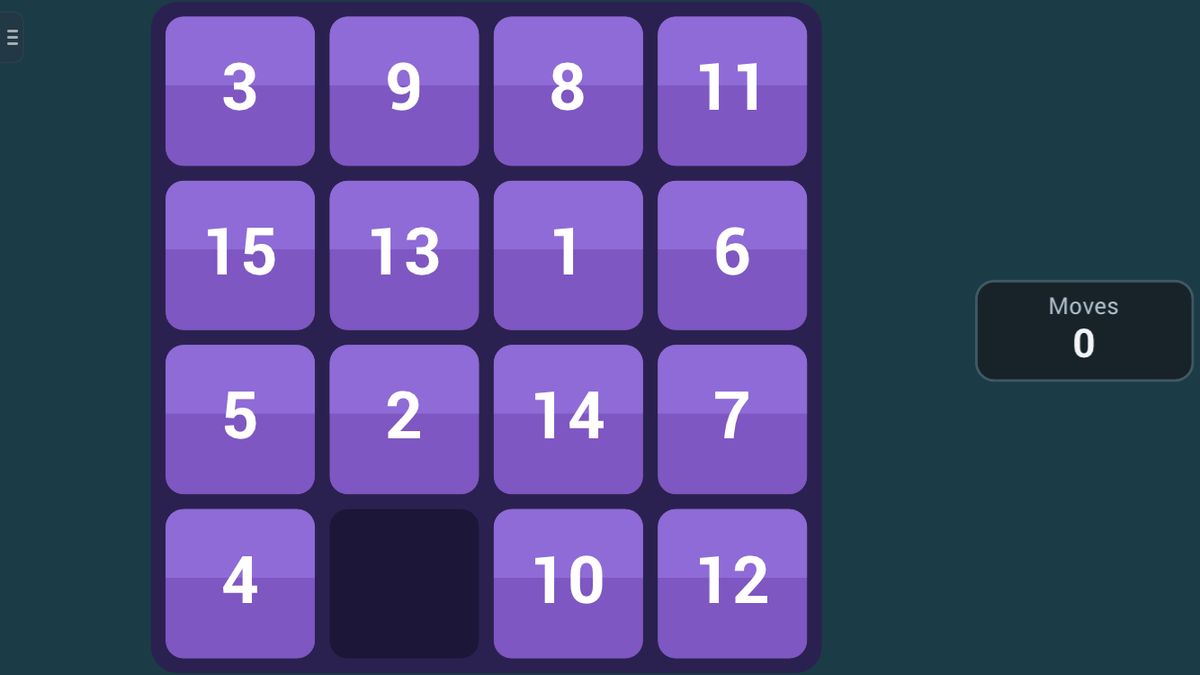
Tile Slide is a square tray of sixteen spaces holding fifteen numbered tiles, 1 to 15, and one empty space. The tiles start mixed up. Slide them, one at a time, until they read 1 to 15 in order, row by row from the top left, with the empty space in the bottom right corner.
How to play
There are no turns. Only a tile right next to the empty space, above, below, left or right, can move. Tap it and it slides into the space, and the space jumps to where the tile was. Tiles never jump over each other, and they never move diagonally.
An example: the empty space is in the top right corner, and the 4 sits just below it. Tap the 4 and it slides up into the corner. Now the space is where the 4 was, and the tiles around that spot can move.
You never move the tile you want directly. You steer the empty space around it, so it can step one square at a time towards home.
Every scramble can be solved: the app makes it by sliding tiles out of order from a finished board, so a way back always exists. It counts your moves as you go.
Scoring and the end of the game
Alone, there is no clock. Keep sliding until every tile is home and the space sits in the corner. The app then tells you how many seconds you took, and the move counter shows how many slides it took.
In a race, both players get exactly the same scramble. You can see how far your rival has got, but never their tiles, so nobody can copy the answer. The first to finish wins. If you finish moments apart, the faster time wins; exactly the same time is a draw. In a race, speed counts, not the number of moves.
Tips to play better
- Solve the top row first, then leave it alone. Once 1, 2, 3 and 4 are home, never disturb them. Then do the second row the same way.
- Do the last two rows together, column by column. Put 9 and 13 in place on the left, then 10 and 14, then finish the last little square.
- The last two tiles of a row need a trick. Park the 4 where the 3 belongs and the 3 just below it. Bring the space to the corner, then slide the 4 across and the 3 up.
- Walk the space in small loops. Circling the space round a small block turns the tiles inside it one step, while everything else stays put.
Common mistakes
- Breaking a finished row. Moving a solved tile "just for a moment" often costs many slides to repair.
- Placing 3 and 4 one by one. Put the 3 home, then the 4 beside it, and the 3 usually has to come out again. Bring them in as a pair.
- Chasing the tile instead of the space. Tapping tiles near the one you want, hoping it moves, wastes moves.
Playing with family
Tile Slide needs only the numbers 1 to 15, and a younger child can enjoy just getting the top row right while a grown-up helps with the rest. Older players can try to beat their own move count.
The guided lesson shows which tiles can move, how the empty space acts as a door every tile must pass through, and the row-by-row way to solve.
There is no computer opponent. Play alone, or, in the app, race a friend together nearby on the same scramble, each on your own phone or tablet, with no Wi-Fi or internet needed. The browser edition is for one device.
Ways to play
- On your ownPlay alone, whenever you like.
- Play together, nearbyOne-on-one with someone in the same room, each on your own phone or tablet. No Wi-Fi or internet needed. In the Jambolaya app.
- Learn by playingA guided lesson on the real game teaches you the rules one step at a time.
 Flood1–2 players
 Blackout1–2 players
 Guess the Word1–2 players
 Sudoku Duel1–2 players
 Nonogram1–2 players
 Word Duel1–2 players
 Letter Storm1–2 players
 Word Grid1–4 players